Governance is a word most editors would call a “passion-killer”. It has probably suffered from its pre-eminent role in the ESG debate — which stands for doing business with environmental, societal, and governance-based considerations in mind. Many have come to see it as an anti-commercial drag factor on companies, associated with box-ticking and obsessing over compliance by non-executive directors.
I viewed it differently by the end of my 15 years at The Sunday Times. I realised that most successes and failures were rooted in the performance of the board — in particular, the chair. Governance should not mean tilting a company away from (or towards) shareholder primacy. It should mean running a board so there is clear leadership, diverging stakeholder interests are carefully weighed, and — above all — executives take a thoughtful approach to long-term value creation.
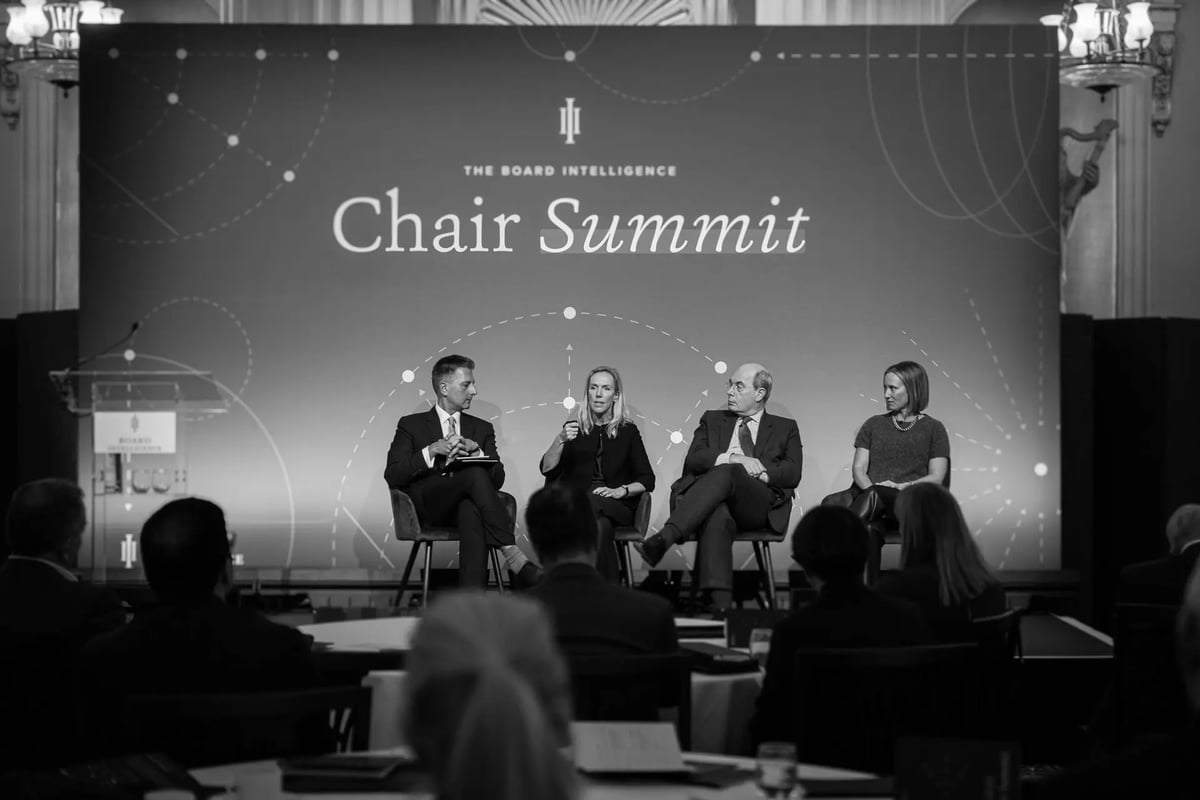
This more nuanced definition of governance was a theme running through Board Intelligence’s inaugural Chair Summit, held yesterday at Mansion House in London.
Board Intelligence laid on an all-star cast for 200 guests including EDF UK chairman Sir Alex Chisholm and ITV chief executive Dame Carolyn McCall. The Rt. Hon. Sir Tony Blair and The. Rt. Hon. The Lord (William) Hague of Richmond gave their thoughts on politics in the UK and beyond to Board Intelligence chief executive Pippa Begg. HSBC non-executive Geraldine Buckingham, KKR European private equity co-head Philipp Freise, and Smith & Nephew chair Rupert Soames discussed how to handle crises. Anne Keast-Butler, the boss of GCHQ, spoke to Board Intelligence co-founder Jennifer Sundberg about geopolitics and cybersecurity. Then Kate Alessi, Google’s UK managing director, Ann Hiatt, Board Intelligence’s chair, and Sir John Kingman, UK chair of Barclays, closed the day with a conversation about stimulating growth and innovation — the primary challenge facing the UK economy.
I left the ensuing drinks reception with several connected thoughts swirling.
In the UK, there is often an assumption that non-executive boards serve to act as a check on executive power — that their focus is risk mitigation. Many do adopt this stance, consciously or unconsciously. But the best boards facilitate risk-taking. They give executives insights and wisdom, encouraging them to do deals, develop products and enter new markets. If things go wrong, they limit the downside. They create cultures of accountability, not blame. The final panel featured a dissection of Amazon and Google’s remarkably long records in doing the above.
The UK is shrouded in gloom on a macro level. But the calibre of speakers and guests from the quoted and unquoted arenas was a reminder of our outsized talent pool. The City’s long history is sometimes portrayed as a handicap — a few years ago, hedge fund tycoon (and now media mogul) Paul Marshall described the FTSE 100 as the “Jurassic Park” of stock exchanges. But with that heritage comes a rich ecosystem and a certain DNA. One panellist, making a contrarian defence of short-term thinking, cited a comment by the GEC empire-builder Lord (Arnold) Weinstock: “The short term leads to the long term.”
That kind of pragmatism lies at the heart of British business.
The third takeaway was the importance of storytelling. Executives are necessarily immersed in the details of running a business. Boards can raise their gaze and help them set out a compelling vision. Turnarounds of big companies are always accompanied by more confident narratives.
Here’s to more of that in 2026. And as for the long term — Board Intelligence will be back with an even bigger and better Chair Summit in 2027.
The views expressed in this article are those of the author.
With Insight Driver, surface the questions worth asking, the stakeholders worth considering, and the context worth knowing.
See Insight driver