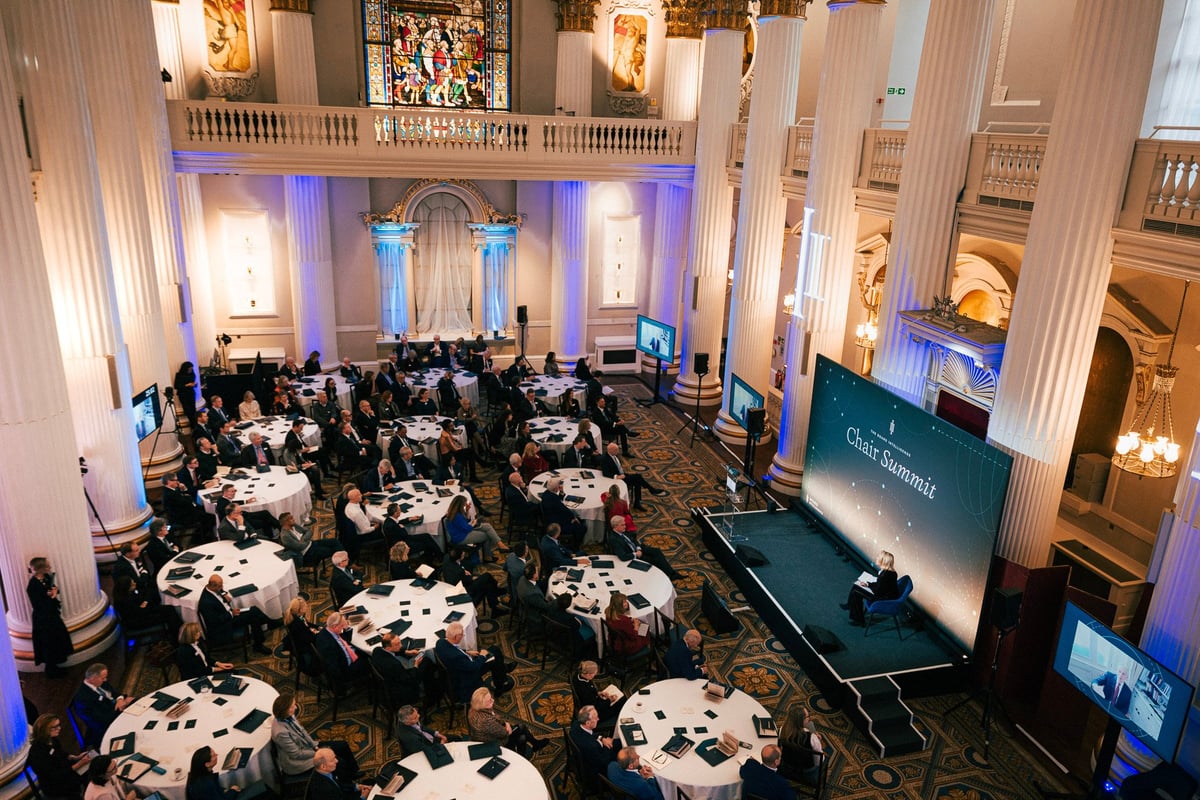
One message rang loud at Board Intelligence's inaugural Chair Summit: businesses are operating in a fundamentally different context — and governance isn't always keeping pace. The Chair Summit brought together 200 chairs, CEOs, and senior directors from Europe's leading organisations for a closed door conversation about the changing business and political context and the future of governance.
The Rt. Hon The Lord Hague of Richmond, former foreign secretary and now chair of the AI Safety Institute, put it simply: "Adapting an organisation or a country for an age of increased danger and increased excitement is, in my mind, the challenge of leadership — whether in politics, business, universities, or anywhere else."
For the leaders in the room — each of them navigating risk and opportunity in equal measure and evolving how they work to meet the demands of a complex, technical, and volatile world — this resonated.
Crises move faster. Cyber threats are escalating. Quantum computing is no longer theoretical. Risks and expectations are accelerating, but so too is the excitement. The opportunities for impact have never been greater.
Across fireside chats and panel discussions with political and business leaders such as GCHQ Director Anne Keast-Butler, Lord Hague and The Rt. Hon. Sir Tony Blair — five imperatives emerged for company secretaries. Each one redefines what needs to be true for governance to be effective in a more complex, technical, and opportunity-rich landscape.
1. Crisis preparedness is no longer optional
When a crisis hits, it takes over. Anne Keast-Butler, in conversation with Board Intelligence co-founder Jennifer Sundberg, described the relentless nature of cyber incidents — an area where secure board portals remain one of the simplest ways to reduce avoidable vulnerabilities. From a corporate perspective, leaders stressed that crises have two phases: addressing the immediate problem and setting a vision for the future. Boards must be prepared for both.
Lord Hague sharpened the point: leaders must build resilience while increasing their organisation's ability to reinvent itself. Company secretaries sit at the centre of that dual challenge.
For company secretaries and their teams, this means:
- Ensuring boards run regular tabletop exercises, not just paper-based reviews.
- Testing decision rights, escalation routes, and communication flows.
- Giving recovery planning as much attention as incident response.
- Building the board's social capital — trust that allows boards to disagree productively under pressure, and which our latest Board Value Index shows is a defining feature of high-performing boards.
The organisations that cope best are those that have rehearsed the worst. For boards looking to strengthen their oversight, the NCSC's Board Toolkit offers a practical framework for understanding cyber risk and the questions directors should be asking.
2. Cyber is a board-level discipline
Cyber resilience is no longer an IT issue. It is a strategic, operational, and reputational risk that sits squarely with the board.
Boards — and therefore governance teams — should ensure:
- Cyber and emerging technologies such as quantum are discussed regularly — in focused, forward-looking discussions rather than sidebar conversations around broader risk or technology agenda items.
- Security is designed into new technologies (especially AI), not retrofitted.
- Supply-chain vulnerabilities are understood and addressed.
- Surprise is expected — every major incident reveals a hidden dependency or blind spot that no one realised was critical until it failed.
And then came the warning that should be on every company secretary's radar: quantum computing.
Quantum, as Keast-Butler pointed out, is no longer a distant prospect — it's now looming very clearly on the horizon. When it arrives, it will break today's encryption in moments. Boards need to ask:
- Which systems and data need quantum-resistant protection?
- How long will the transition take?
- Who is accountable for preparing?
Lord Hague's geopolitical warning — comparing the international order to a Jenga tower with bricks quietly being removed — underscores why cyber resilience can no longer be treated as a technical afterthought.
3. Narrative management demands board attention
The US regional bank runs showed how quickly a narrative can take on a life of its own. Rumours spread online faster than the banks could correct them. Communications can no longer be thought about at the end of a crisis response process — it needs to be baked into the plan from the get-go.
For company secretaries, this means elevating narrative management to a board level discipline:
- Ensuring the organisation has a distinct social media protocol for crises — clarifying how issues are monitored, escalated, and communicated under pressure.
- Stress testing how misinformation might spread and how quickly the organisation could respond.
- Ensuring internal communications are as strong as external.
In a crisis, silence is not neutral. It is narrative-shaping.
4. Innovation requires new governance models
Rapid technological change demands new ways of working from boards. Defaulting to caution will only hold organisations back. Ann Hiatt's reflections on Silicon Valley reinforce this — showing how speed, experimentation and empowered teams can unlock strategic advantage.
The speakers in our panel discussion on growth and innovation — Ann Hiatt, Google UK's Kate Alessi, and Sir John Kingman — argued that innovation requires:
- Clarity on what is not changing — the anchors that guide decision-making.
- Shorter experimentation cycles — not long, linear planning.
- Delegated authority ("single threaded leadership") to accelerate decisions.
- Boards willing to tolerate imperfection in service of speed.
The panel reinforced that the UK's competitiveness in AI will depend on infrastructure, energy access, and regulatory clarity — all areas where boards can and should engage government more assertively.
Lord Hague's reminder that countries succeed when they combine "talent, technology, and capital" gives company secretaries a powerful lens for shaping board conversations about long-term capability.
5. Board effectiveness is structural, not soft
One of our speakers shared an interesting perspective on the value of NEDs — that most of the time, NEDs are in training for the moment when they will be truly needed. When that moment comes, the board's effectiveness depends on:
- The diversity of perspectives around the table.
- The quality of relationships built in the quiet times.
- The ability to disagree constructively.
- The chair's ability to create alignment without suppressing challenge.
The importance of global perspectives was emphasised, especially for organisations exposed to geopolitical tension. And our speakers, across several sessions, reminded the leaders in the room that long-term thinking is possible in both the public and private markets, despite short-term pressures from financial markets and investors, social media, and the 24-hour news cycle — but only when incentives are aligned.
For company secretaries, this means being intentional about board development, induction, evaluation, and information flows. Culture is not soft. It is structural — and these foundations shape how a board thinks, behaves, and makes decisions.
What this means for company secretaries
The 2026 Chair Summit made one thing clear: we need to accelerate the pace with which board governance is adapting to the realities of a complex, technical, and volatile world. Company secretaries play a critical role in helping boards navigate cyber risk, crisis readiness, geopolitical uncertainty, and rapid technological change.
The organisations that thrive will be those whose boards are informed, rehearsed, and future focused — and the governance professionals who support them will be central to that progress.
With Report Writer, you can go from blank page to ready-to-share paper in a blink, with the help of AI built on 20 years of report writing expertise.
See report writer