
Board governance is the system of rules, practices, and processes that guide how a board operates and fulfils its responsibilities.
Here are the key points at a glance:
- Strong governance enables long‑term value creation by sharpening strategic focus, building trust, ensuring compliance, managing risk, and creating the conditions for innovation.
- The principles of good governance include independence, transparency, clear responsibilities, effective risk oversight, alignment with purpose and values, and ongoing performance evaluation.
- Common board governance challenges include information overload, lack of diversity, complex regulations, poor succession planning, and weak internal reporting that obscures key risks and insights.
- To strengthen board governance, start with regular evaluations against a consistent best‑practice framework and then focus improvement efforts where they're most needed, whether in board composition and skills, clarity of roles and decision‑making frameworks, the quality of information and reporting, risk and control structures, or how agendas are shaped across the year, supported by the right technology.
How do you define board governance?
Board governance is a subset of corporate governance, focusing specifically on how the board of directors operates — its structures, responsibilities, behaviours, and practices within the context of a wider corporate governance framework. That means it covers how the board is composed and how it delegates authority, what individual directors must do under law (such as the Companies Act 2006 in the UK, or fiduciary duty and duty of care in US states), and how the board remains accountable to shareholders, employees, regulators, customers, communities, and the environment. It refers to how directors supervise and steer the organisation towards long-term success— meeting legal duties and ethical standards, balancing performance and risk, and delivering for stakeholders.
Why does board governance matter?
Effective board governance sets the framework for sound governance practices and organisational performance. It creates the foundation for agile, robust decision-making and effective oversight — ensuring organisations can thrive, even when the unexpected happens.
Behind every corporate success story is a high-performing board. Companies don’t succeed in the long-run in spite of their board — they’re enabled and sustained because they put effective governance structures in place. These structures systemise good intentions and turn them into high-performance behaviours.
Pippa Begg, CEO, Board Intelligence
Boards are costly to run, and governance itself is an investment that has to deliver a return. Good governance does that by:
- Fostering agility and helping the organisation spot risks and opportunities early and adapt to volatile business environments.
- Enabling high-quality decisions that sharpen strategy and allocate resources wisely.
- Empowering management to innovate and take smart risks.
- Making time and space for big-picture, future-facing conversations that move the business forward.
- Building trust and confidence among investors, regulators, and other stakeholders in how the company is run.
- Protecting the organisation legally; well-governed boards are better placed to avoid scandals, regulatory sanctions, and failures that can damage reputation and value.
- Supporting sustainable growth by aligning strategy and operations with culture, purpose, and long-term thinking.
Effective board governance, in short, ensures boards are a driver of strategy and performance rather than a drag on it.
What are the key roles and responsibilities of the board?
A board of directors is the company's ultimate oversight body, responsible for hiring and monitoring the CEO, setting strategic direction, managing major risks, and ensuring the company effectively serves its shareholders and stakeholders.
Boards typically include a chair, non-executive directors, and executive directors, each bringing independent judgment and diverse expertise to the table. Committees support the board by allowing deeper focus on specific areas — such as audit, remuneration, or risk — while the full board retains overall oversight.
The chair's role
As the leader of the board, the chair sets the tone, shapes culture, and creates an environment for independent challenge. In practice, that means setting and owning the agenda, running board meetings effectively, and serving as the primary liaision between the board and CEO — ensuring topics are properly planned rather than left to Any Other Business (AOB).
Separating the chair and CEO roles is widely regarded as best practice. In the UK, the Corporate Governance Code recommends it, and it's increasingly the norm in the US where 60% of S&P 500 boards now divide the two responsibilities. According to Chris Perry, President of Broadridge Financial Solutions and a board member at the Financial Services Institute, this sets the stage for the purest dynamic as it creates and preserves independence in board governance from executive management.
Duties of board members
Directors bring diverse expertise and independent judgment to strategic decisions. They're expected to ask tough questions, challenge management when necessary, and provide guidance based on their experience. Each director has equal voting power and a legal duty to act in the company's best interests, ensuring compliance with laws and regulations, and exercising reasonable care, skill, and diligence.
In the UK, these duties are set out in the Companies Act, and in the US they are defined by state law and stock‑exchange or regulatory requirements. Across the Middle East, duties vary by jurisdiction, with local company laws and regulatory bodies setting the expectations for directors.
Beyond legal compliance, directors are expected to actively engage in strategic oversight, risk management, and financial reporting — bringing the same rigour and independence to each.
Role of committees
Committees allow boards to delegate detailed scrutiny of critical areas while maintaining overall oversight — helping to manage complexity and distribute workload across the board.
Committees should have charters, a clear mandate, and established reporting lines. Many boards require a majority of independent directors on key committees to avoid conflicts of interest.
The key committees and their roles are:
- Audit committee: oversees financial reporting, internal controls, and external auditors.
- Compensation/remuneration committee: sets executive pay and ensures that it aligns with performance.
- Nominating/governance committee: recruits new directors and maintains governance standards.
- Risk committee: monitors enterprise-wide risks including cybersecurity.
What are the principles of effective board governance?
Effective board governance is built on several core principles:
- Strategic alignment, where purpose, values, and culture connect clearly to long-term thinking.
- Independence and balance, with independent non-executives, diverse skills and a range of perspectives around the table.
- A forward and backward balance, ensuring boards steer strategy and enable innovation while maintaining supervisory oversight of past and current performance.
- Collaboration, with a high level of trust between the board and management, is essential to effective governance.
- Transparency and disclosure, with reporting to shareholders and stakeholders covering financials, risk exposures, remuneration, and non-financial metrics.
- Clear roles and accountability, so everyone around the table knows what they're responsible for.
- Risk oversight, with robust internal controls to manage both financial and non-financial risks, from cybersecurity to environmental risk compliance.
- Regular evaluation of board performance, its committees, and individual directors.
What are the common challenges in board governance?
Despite the clear benefits of effective governance, many boards fall short. The Board Intelligence Board Value Index, a survey of more than 200 board members, found that a third of directors think their board adds no value — and the data points to why. Only 21% of directors report a balanced approach to their use of time, 34% say their board focuses mainly on past activity, and 10% admit that more than 80% of board time looks backward.
According to PwC's Governance Insights Center, boards today can't rely on yesterday's skills (PwC report: Trends shaping corporate governance in 2025). Instead, boards need to examine the expertise around them, spot gaps, and actively close them through ongoing education.
At the same time, the most effective boards are turning to tools that improve the quality of insight rather than simply speeding up administration. Insight Driver helps boards cut through information overload by highlighting the patterns, risks, and opportunities that matter most, giving directors clearer context and sharper judgement in every meeting.
Boards can face several challenges:
- Information overload makes it easy to miss key risks or insights. Research by Board Intelligence and the Chartered Governance Institute UK & Ireland shows board packs are getting longer, less useful, and costlier to produce.
- Behavioural factors, such as dominant personalities, groupthink, bias, lack of challenge, and inadequate independent voice, all of which affect board effectiveness.
- Firefighting and short-termism, where boards get pulled into operational detail or find themselves stuck looking in the rear-view mirror rather than at the road ahead.
- Blindspots, where boards focus on the topics that matter to them or management, rather than the topics that matter most to the business.
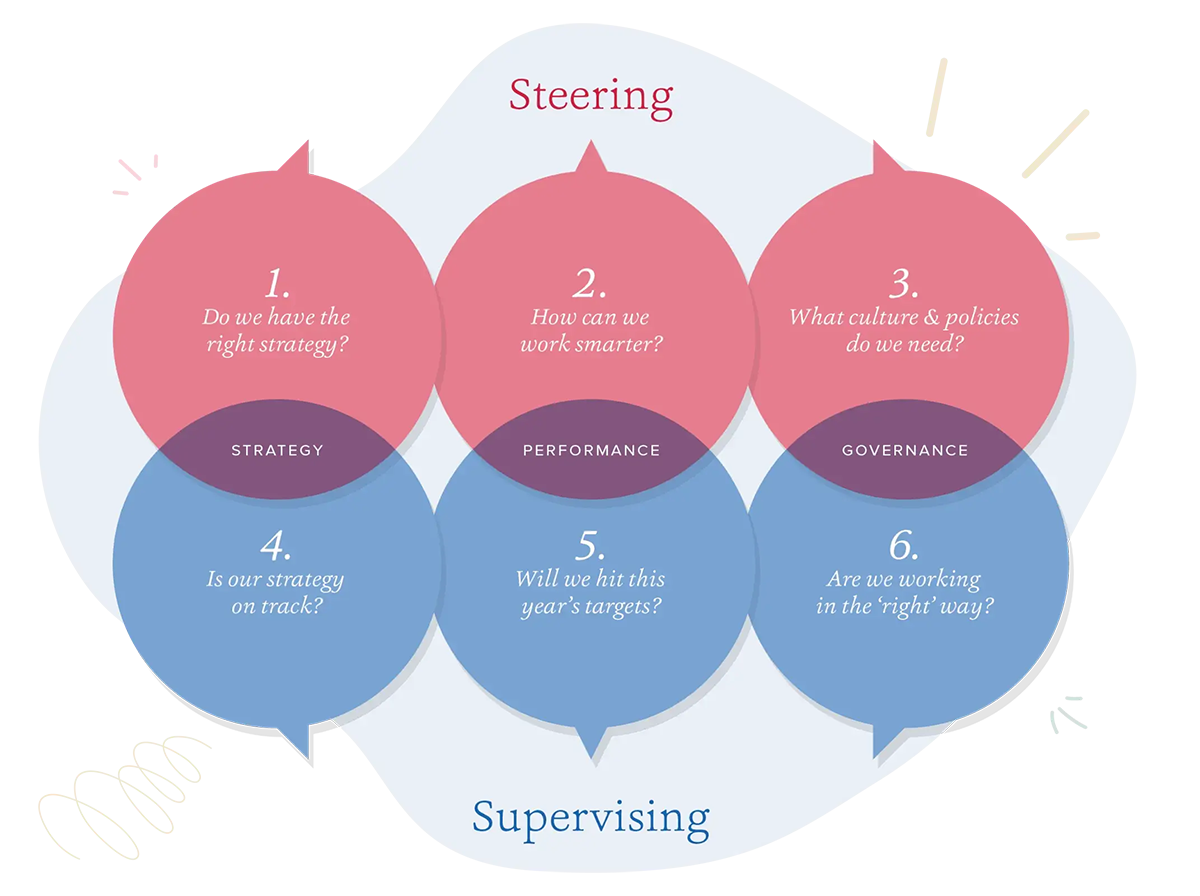
- An imbalance between steering and supervising — leaning too heavily on one of their core responsibilities, such as steering (setting direction and strategy) or supervising (providing oversight and accountability), while neglecting the other. A well-functioning board needs to balance both.
- Evolving regulations around ESG, climate, and data privacy, alongside technology risks and global supply chain complexity, create rapid change that boards need to stay on top of.
- Succession planning deficits, with boards failing to prepare for turnover or build sufficient diversity and depth in the senior leadership bench. The Azets Barometer (Jan 2024) found that although ~58% of UK businesses had considered succession planning in their strategy, only 9% had it fully integrated.
- Poor disclosure and inconsistent reporting, with non-financial risks underreported, internal controls poorly articulated, and stakeholder communications delayed or fragmented.
How to strengthen board governance using the Five I’s
Effective governance is the backbone of a company's credibility and long-term success. When boards get it right, they create trust, reduce risk, and position the organisation to thrive even in uncertain times.
Here are practical steps your board can take.
Audit your board composition and diversity
Review whether you have enough independent directors, a variety of skills and backgrounds, and sufficient representation of gender, ethnicity, or other attributes that matter.
The Harvard Law School Forum on Corporate Governance Board Practices and Composition: 2024 Edition shows that diversity in skills, backgrounds, and demographics correlates with more effective board oversight and decision-making. The report points to a growing demand for directors with broader skill sets — including global outlooks, sharp business acumen, technological know-how, strong governance expertise, and a deep understanding of human capital management (HCM).
Clarify roles and responsibilities
Make sure the chair, CEO, CFO, and other board members have clearly defined responsibilities, and that committees operate with well-structured scopes and charters.
Above all, good governance depends on a strong, collaborative relationship between the board and management. Both must work toward the same goals and be focused and aligned on shared priorities.
Tip: To learn more about these roles, read our interviews with leading chairs, CEOs, CFOs, company secretaries, and non-executive directors.
Enhance risk management and internal control frameworks
Boards are responsible for setting the risk management framework – defining policies, clarifying roles, and ensuring compliance with governance standards. In practice, this means maintaining oversight of both financial and non-financial risk and putting in place robust internal control systems to identify and respond to emerging risks.
Risk and innovation are closely linked. A consistent theme from the Chair Summit was that boards innovate best when they manage risk well, not when they avoid it. Chairs spoke about creating the conditions for bold thinking while maintaining clear boundaries, so directors can explore new ideas with confidence. By setting a clear risk appetite and an oversight framework that supports thoughtful experimentation, boards turn calculated risks into opportunities for strategic advantage. You can read more about how boards balance risk and innovation in our blog on this topic.
Improve transparency and reporting
Clear, balanced reporting is a mark of good governance. Commit to transparent financial, ESG, and other material risk disclosures, and maintain high-quality reporting standards, timely stakeholder communication, and honest explanations of strategy and performance.
Improve your reporting with our guides:
- Improving and managing board papers
- How to write better board papers
- The definitive guide to decision papers
- Using AI for more effective reporting
- A guide to creating effective board packs
Tip: Improve your board packs by following the Question-Driven Insight (QDI) Principle. This method ensures that each paper is built on critical thinking, communicated effectively, and focused on what matters.
We’ve adopted the QDI Principle to help us think through the questions we should be answering and the storytelling behind our reports.
Rachael Turk, Beazley (FTSE 100 insurer)
Regular performance evaluations and continuous improvement
Use internal and external reviews to assess board and director effectiveness. Where possible, benchmark with peers and use evaluation findings to inform training, adapt governance structures, or adjust board processes.
Board Intelligence's board evaluation methodology goes beyond standard assessments by examining five dimensions: impact, innovation, individuals, information, and infrastructure. Unlike many board reviewers, we focus not only on governance fundamentals but also on how effectively boards drive meaningful outcomes and encourage fresh thinking — producing a detailed report that highlights strengths, identifies areas for development, and provides tailored, actionable recommendations.
Leverage technology and tools
Our Board Value Index found that poor-quality information is one of the biggest barriers to effective board decision-making, cited by more than a quarter of directors. The Board Intelligence platform is designed to address this directly. Here's how:
- The Agenda Planner Tool allows you to schedule meetings across the year while providing insight into how the board is allocating its time and attention — helping identify gaps and ensuring the forward calendar is structured around the Six Conversations Model.
- Report Writer, Board Intelligence's AI-powered management reporting platform, helps align board papers with strategic priorities – letting you tag papers by topic and link their content to specific board or organisational goals.
- Apply Board Intelligence's Six Conversations model that examines the three key reporting areas — strategy, performance, and governance — through the board's dual roles of steering and supervising. It helps boards identify the missioncritical discussions that will help the organisation deliver its big-picture vision and goals.
TIP: Book a demo to see how the Agenda Planner organises forward calendars, simplifies agenda administration, and tracks time spent on strategy, performance and governance.

With the “easiest to use board portal on the market”, powered by enterprise-grade security, first-rate support, and features that set your board and governance team up to succeed.
Book a demonstrationFAQs
-
What is the main purpose of board governance?Board governance provides oversight, accountability, and strategic guidance so that the company can achieve sustainable success. It ensures that decisions are made responsibly, risks are managed, and stakeholder interests are protected.
-
Who is responsible for board governance?
The board of directors collectively is responsible for governance, with the chair leading and committees supporting specific areas. Individual directors also have fiduciary duties under the law.
-
How does board governance differ from corporate governance?
Corporate governance is the overall framework of rules and practices guiding how a company is controlled. Board governance is one part of that system, focusing specifically on the board’s structure, behaviour, and oversight responsibilities.
-
What are the core principles of board governance?
Key principles include accountability, transparency, independence, clear roles and responsibilities, effective risk oversight, alignment with purpose and values, and regular performance evaluation. Together, these principles guide how boards oversee management and serve stakeholders.
-
What challenges do boards face in governance?
Boards commonly struggle with information overload, behavioural factors such as groupthink, poor succession planning, and rapidly changing regulatory demands. They must also balance short-term pressures with long-term strategic oversight and avoid spending too much time looking backward rather than forward.