The chief of staff is one of the most consequential roles in any organisation, and one of the least understood. In governance especially, it rarely receives the attention it deserves. Chiefs of staff are not typically named in governance frameworks or regulatory guidance. Yet in practice they shape what reaches the board, how it is framed, and whether the conditions for a good conversation exist before anyone takes their seat. That makes them a significant, if largely invisible, force in board effectiveness.
Our Board Value Index found that average confidence in boardroom decision-making sits at just 30.8 out of 100, and that poor-quality information is among the biggest barriers directors identify. Getting the right information to the right people, in the right form, is work chiefs of staff are uniquely positioned to do.
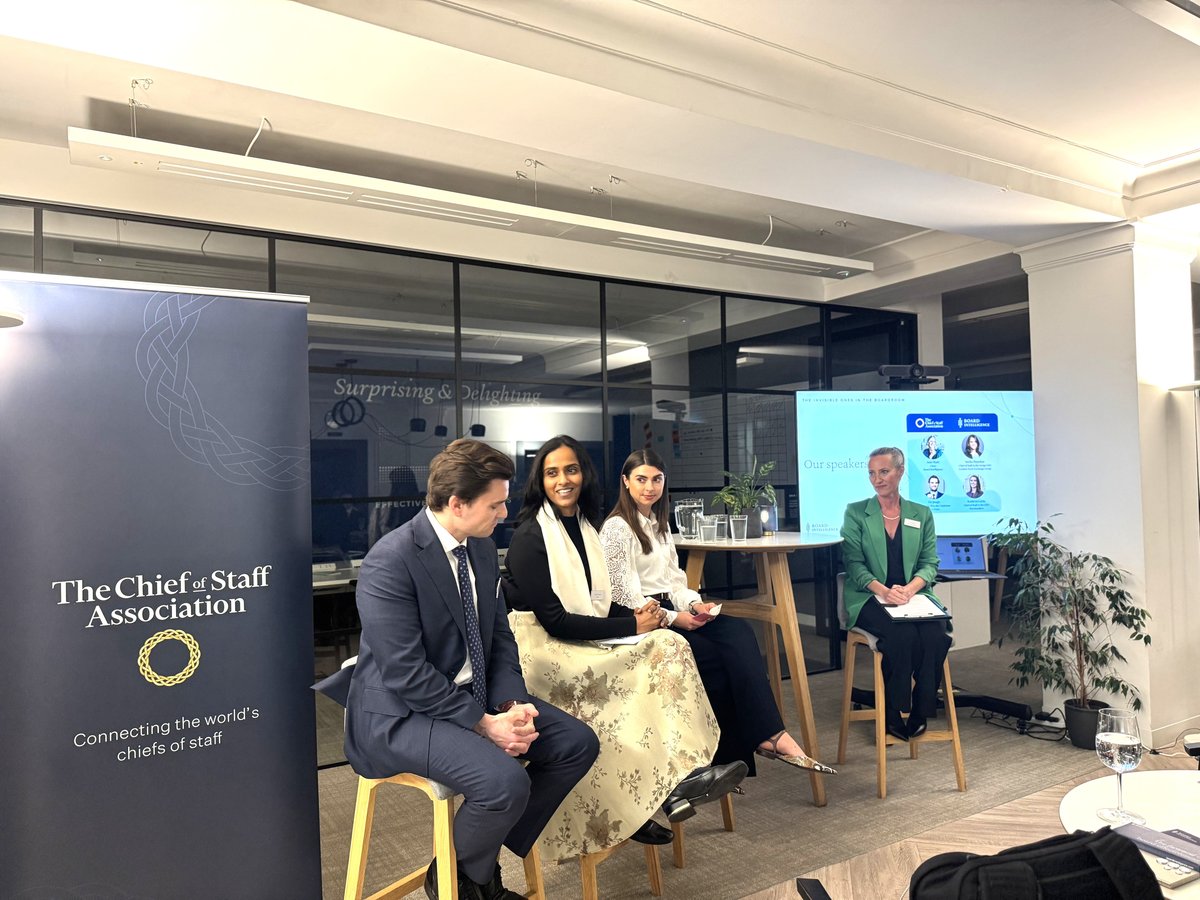
Board Intelligence and the Chief of Staff Association brought together senior practitioners to explore exactly that: the role chiefs of staff play in board effectiveness, and how they can dial up their impact. Sneha Manohar, Chief of Staff to the Group CEO at London Stock Exchange Group, Oz Jungic, Chief of Staff to the Chair at Rio Tinto, and Kathryn Larin, Chief of Staff to the CEO at Marshmallow, joined Ann Hiatt, Chair of Board Intelligence and former Chief of Staff at Google.
Three themes emerged:
- Trust comes before influence. Chiefs of staff who earn authority through consistent, reliable behaviour, rather than the seniority of their title, are the ones boards and principals genuinely rely on.
- Invisibility is a feature, not a failure. The most effective chiefs of staff do their most important work before the meeting begins, in the conversations, pre-reads, and quiet interventions that shape what happens in the room.
- Information quality is a governance issue. What goes into a board pack determines the quality of the conversation that follows. Chiefs of staff who treat pack preparation as a discipline, rather than a logistics task, can materially improve how boards spend their time.
Trust is earned before you're given the seat
One of the most consistent themes of the evening was trust, and how it starts long before the job title does. By the time someone is offered the role, the foundation has usually been building for years.
The panel described trust not as something you announce or demand, but as something built through small, consistent acts. Turning around a promised follow-up on the day you said you would. Saying "I don't know" and meaning it, rather than filling a silence. Asking the question nobody else wants to ask. These are what the panellists called the "hygiene factors", the things people quietly notice and remember.
For those new to the role, the advice was clear: invest early in relationships across the organisation, not just upwards. One panellist described spending their first two weeks in 60 meetings with stakeholders at every level, not to extract information, but to understand what mattered to each person and what they were hoping to contribute. Understanding what someone genuinely cares about changes the dynamic. You're no longer managing a relationship, you're building one.
The panel drew a distinction between rank and authority. A chief of staff has rank by virtue of the role. But authority is different. It's the reason people bring you problems, test ideas with you, and act on your advice. And it's earned through consistent, reliable behaviour over time.
Top tips
- Invest early in relationships across the organisation. Spend your first weeks meeting stakeholders at every level to understand what matters to them and what they want to contribute.
- Demonstrate reliability in small things. Follow up when you said you would. Say "I don't know" and mean it. Ask the question nobody else wants to ask.
- Put your old role aside. It's tempting to fall back on your previous expertise, but this role requires something different and it takes deliberate effort to make that shift.
- Your principal's world is now your world. Read what they read. Go where they go. The more context you carry, the more useful you become.
Visibility is not the goal
If you're doing this job well, you're nearly invisible. The panel were unanimous on this. The work that matters most happens before the room fills up: the pre-meets, the quiet conversations, the moment when a board member or executive tests out an idea informally and you can give them an honest signal before it reaches the table.
As Ann described it from her years at Google and Amazon, "you're the swan — smooth on the surface, frantically paddling below."
That invisibility, the panellists agreed, is not the same as absence. People in the room, whether board members or senior executives, know how much work went into getting them there. They know which conversations have already happened and who facilitated them. The chief of staff's presence looms ahead of the meeting, even when they're not a voice within it.
This is also where the role carries real influence. A chief of staff who has earned the trust of board members becomes a safe channel for testing ideas, surfacing concerns, or flagging when something might land badly. That informal access is one of the most valuable things the role can offer.
Top tips
- Do the work before the room fills up. Pre-meets, quiet conversations, and informal signals to board members or executives ahead of a meeting are where the real influence sits.
Boards are only as good as the information they receive
Our Board Value Index found that one in four directors cites poor-quality information as a barrier to making good decisions. Getting the right information in front of the right people, in the right form, is not a support function. It is the work.
The panel offered some practical principles. Everything important should come first. Every section should have a clear ask. "What is the state of play, what is going well, what is not going well, what are we doing about it, and what is the ask?" — that structure was described as a discipline as much as a format. Boards are time-poor and their attention is genuinely limited. A chief of staff's job is to make every page earn its place.
But data alone doesn't tell the full story. Several panellists raised the importance of tone, the human judgement about how something will land, whether a particular framing will create unintended friction, whether the voice in a paper sounds like the person who wrote it or like a committee. That, the panel agreed, is the part of this role that no AI tool can do. It requires knowing your principal, your board, and the room.
Our data reinforces why getting this right matters. 80% of directors say their board discussions get too deep into operational detail. The quality of what goes into the pack shapes the quality of the conversation that follows.
Ann recalled a board member at Google who appreciated that his dietary preference was always remembered. A small thing. But the point was that it made him feel confident every other detail had been handled with the same care. That's the signal chiefs of staff send through the small stuff, and it matters more than most people realise.
Top tips
- Structure every section around a clear ask. State the situation, what is going well, what is not, what you are doing about it, and what you need from the reader.
- Make every page earn its place. Boards are time-poor. Cut anything that doesn't help them make a better decision.
The question nobody asks enough: what's missing?
Several panellists identified a single question as the most valuable a chief of staff can ask before a pack goes out: "What's missing?" Not as an edit, but as a genuine prompt, whether to a colleague, a trusted internal authority, or the principal themselves. Is there an underlying assumption that hasn't been examined? A perspective that hasn't been sought? A piece of context that everyone in the room might take for granted but a board member wouldn't have?
The panel were clear that this only works if the relationships are already there. As papers travel through an organisation, things get lost or assumed. A chief of staff who has invested in those relationships can go back to trusted people informally before anything is finalised, not as a final edit, but to ask: is anything missing? Are you comfortable with this? Would you say anything differently? It's a small act, but it's often the one that catches what everyone else has missed.
Top tips
-
Before a pack goes out, ask a trusted colleague or the principal directly: is anything missing? Is there an assumption that hasn't been examined, or a perspective that hasn't been sought?
The chief of staff at their best
The chiefs of staff who have the greatest impact on board effectiveness are not the ones with the loudest voice in the room. They are the ones who have done the work before anyone arrives, who have asked the questions nobody else thought to ask, and who have quietly ensured that the board has everything it needs to make good decisions. That is governance work. And the more deliberately chiefs of staff own it, the better boards will function.
Ann summarised the chief of staff value in the metaphor of the kite string. The best chiefs of staff don't hold their principals back. They give them the freedom to fly as high as possible, while keeping them connected to the ground. The string matters as much as the kite.
With Insight Driver, surface the questions worth asking, the stakeholders worth considering, and the context worth knowing.
See Insight driverFAQs
-
What is a chief of staff?
A chief of staff acts as a senior strategic partner to a CEO, chair, or other principal. The role involves managing the flow of information, decisions, and priorities to and from the principal, ensuring the right people are engaged at the right time and that nothing important falls through the gaps. The specifics vary by organisation, but at its core the role is about making the principal, and through them the organisation, more effective.
-
What role do chiefs of staff play in governance?
Chiefs of staff are not a formal part of governance structures, but they influence governance in practice. They often control what reaches the board, how papers are framed, and which conversations happen before a meeting. A chief of staff who understands what good board information looks like, and who has the relationships to act on that knowledge, can improve the quality of board discussions, reduce the risk of the board getting lost in operational detail, and help ensure that meetings are spent on the questions that matter most.
-
How does the chief of staff role relate to the company secretary?
The chief of staff and the company secretary often share territory, particularly around board preparation and information flow. The distinction is roughly this: the company secretary owns the formal governance process, including compliance, minutes, and statutory obligations. The chief of staff owns the informal one, including what reaches the principal, how decisions get made, and whether the conditions for a productive board conversation exist. The two roles work best when they work in close alignment.
-
What does good board preparation look like for a chief of staff?
Good board preparation means more than logistics. Our Board Value Index found that average confidence in boardroom decision-making sits at just 30.8 out of 100, and that poor-quality information is one of the most commonly cited barriers to good decisions. For a chief of staff, that means asking whether papers give the board what they need to make a decision, whether the structure is clear, whether the ask is explicit, and whether anything important has been assumed rather than stated. The chiefs of staff who have the most impact on board effectiveness are those who treat that question as their responsibility.