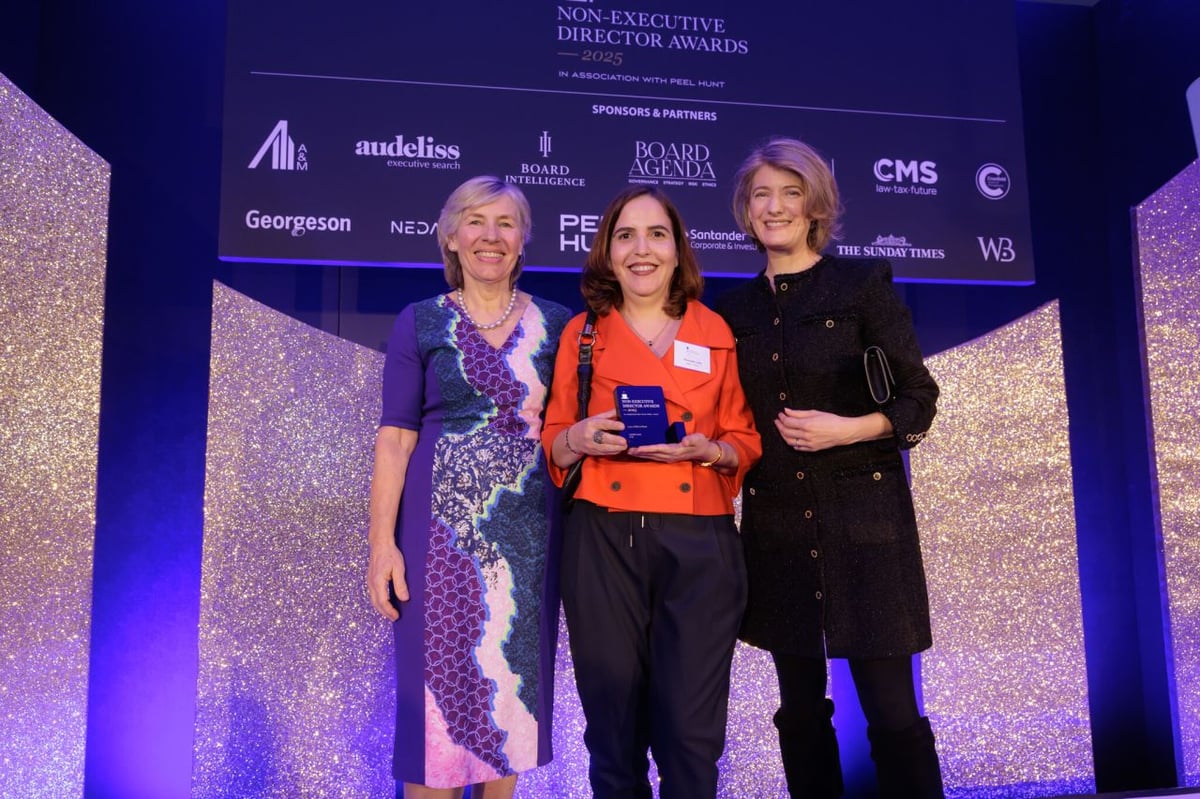
Ahead of the 2026 NED Awards, we interviewed three past winners of the Dame Helen Alexander NED to Watch award to explore how the non-executive director's role is changing, how they keep ahead, and what winning the award meant to them.
Many paths can lead to the boardroom
Salma Shah was not expecting to win the Dame Helen Alexander NED to Watch award at the 2024 NED Awards. She had only been a board member for two years, at Mitie Group and helyo, and didn't have a 'typical' non-executive background — her early career was as a government special adviser and in public affairs.
"It was nice to have the recognition that there isn't only one path or archetype for being effective as a NED," Shah says.
Mitie's board clearly had the same view. "There's a lot of talent in British public life, people who can bring something to commercial boards," she says.
The value of continuous learning for NEDs
The search for fresh perspectives and talent pools comes amid increasing pressure on board members.
"There is a structural trend that started 10 or 15 years ago, to expect more and more from NEDs. The bar keeps rising in terms of the number of topics NEDs are expected to get involved in," says B&M non-executive Hounaïda Lasry, who won the NED to Watch award in 2025.
This doesn't mean that an effective NED is an expert in every external or internal factor that could affect a business, from ESG and reputation to geopolitics and AI. But it does mean that they need to be able to critically appraise information and contribute to discussions across a wide range of business-relevant topics.
Shah says that this means NEDs need curiosity above all. "You have to want to learn, and engage, and ask questions until you get to the point of understanding," she says, adding that non-executives ought to proactively seek conversations with the executive team outside of board meetings, to get that understanding.
Non-executives also add value by bringing an outside-in view, which makes it easier for them to challenge assumptions. But this too requires them to be well and widely read.
Broadening horizons
For Dianne Walker, who won the NED to Watch award in 2019 and now sits on the boards of Inspired plc, Development Bank of Wales, and Victorian Plumbing, among others, continuous learning is also key to a broad and varied non-executive career.
"I was a finance and governance professional at PwC, so I was experienced from that point of view, but I invested time to develop skills and understanding in the tech and HR agendas. I was lucky to evolve out of the audit committee chair role — where I'd naturally been drawn — to broader things," Walker says.
She cites winning the Dame Helen Alexander NED to Watch award as key to enabling that to happen.
"Winning the award opened up my network to many people that I wouldn't otherwise have come across. It brought me into a wider circle of people who did the same job at a higher level, and some very generous leading women in NED roles sought me out for no other reason than just to help," Walker adds.
Additionally, her advice is that while it is wise to expand your range of expertise, don't spread yourself too thin. In particular, resist the temptation as a new NED to take on additional board roles as quickly as possible, which can limit the time you're able to devote to each. In Walker's case, she once sat on six boards but has consciously brought that down to an average of four.
Finding time — and perspective
Time is an important constraint on non-executives' ability both to engage with the particulars of their respective boards — though concise board papers certainly help — and to keep learning more broadly.
"NEDs need to be agile and constantly informed. When a NED is also an executive [elsewhere], it's easier. But if you're no longer an executive, it won't come automatically. You have to make the effort to stay informed," says Lasry.
Fortunately, there are more opportunities than ever to keep learning, whether through seminars, newsletters, reports or structured training as part of board development. "The toughest part is not really to access the information, it's to filter it," Lasry adds.
Her parting advice for the next generation of NEDs is to remember the basics.
"People sometimes have the impression that everything is changing. It's not true. The context is changing, but business fundamentals are timeless: understand your customers and serve them better than your competitors," Lasry says.
This requires NEDs to have a combination of hard skills, business acumen, systems thinking, and strategic nous — as well as soft skills: "You can't really have an impact without soft skills. Your thinking can be flawless, but you won't have the power to influence things."
The winners of the 2026 NED Awards will be announced in March.
Empower your board and directors with upskilling solutions that give them the insight they need to succeed.
Find out more