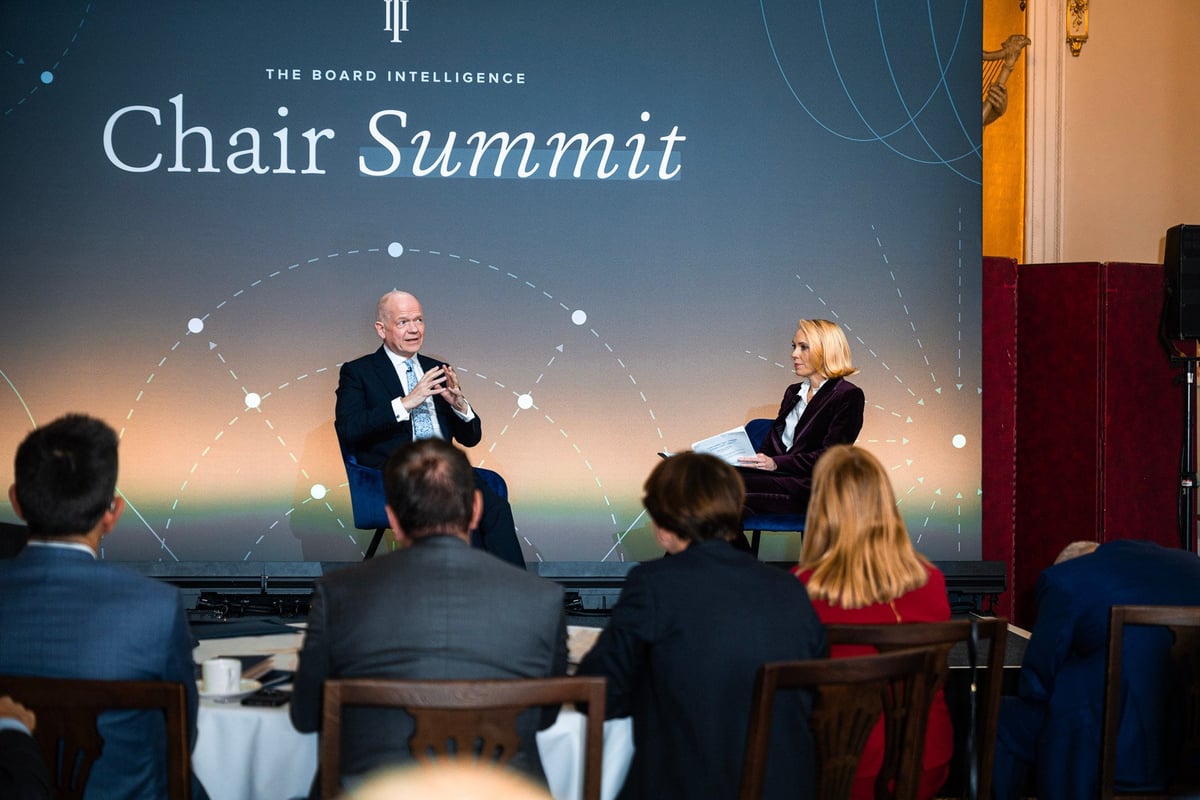
As The Rt. Hon. the Lord Hague of Richmond told the Board Intelligence 2026 Chair Summit, the international order is like a Jenga tower. It will keep holding as the bricks come out — until suddenly it doesn't.
Over the last decade, at an accelerating pace, the geopolitical certainties of the post-1990 era have started to come undone: multilateralism, the dominance of the United States and of liberal democracy, international law, peace in Europe, free trade, human rights, nuclear non-proliferation, the western alliance itself.
Business leaders may mourn the lost stability. Some may even hope that normal service will eventually resume. Lord Hague was quick to dispel such notions.
But beyond the warning lies a more nuanced view of what this turbulence demands.
The challenge of adaptation
There was great cause for hope at the Summit, rooted in the extraordinary transformation of science and technology, including AI, which offers unprecedented opportunity. In the current climate, Lord Hague said, we are dealing with increased danger and increased excitement at the same time, which is why boards need to ask themselves: am I making my organisation continually more resilient? And am I increasing its ability to reinvent itself? Because if you're not doing those two things, you're not preparing to deal with this dual challenge.
"This is not a blip. We're losing the international order. It's like a Jenga tower — it's amazing how many bricks you call pull out, and then everyone's shocked when it falls over, ages after that first brick was taken out.
The Rt. Hon. The Lord Hague of Richmond
This duality — danger and opportunity — pervaded every conversation, with speakers and panellists including Lord Hague's old foil, former UK Prime Minister The Rt. Hon. Sir Tony Blair, Smith & Nephew chair Rupert Soames, HSBC board member and former Blackrock Asia Pacific chair Geraldine Buckingham, and KKR co-head of European private equity Philipp Friese.
All agreed that the new world requires resilience and the ability to reinvent, both quickly in the short term and profoundly in the long run. It would no longer suffice to plan for steady 2% real growth every year. The sharp turns of technology and geopolitics will mean higher highs and lower lows, and organisations need to adapt accordingly.
Yet what also dominated every conversation at the Chair Summit was recognition of a common challenge: the gap between strategic ambitions and execution. Institutional inertia and economic constraints are real barriers that many organisations face — which is precisely why boards have such a critical role to play in accelerating that shift. The good news is that awareness of the challenge is the first step.
The assembled chairs were keen to understand how to navigate and thrive in this new environment. Several key themes emerged from the discussions.
Vision is vital
In the face of uncertainty and disruptive change, the fundamentals matter most. This means getting the basics right — understanding where you're going, why, and how you intend to get there. Without this clarity, it's easy to spend all your time tactically dealing with what the next day brings, rather than sitting back to ask where you're truly headed.
When it comes to executing change, leadership is ultimately about people. With a few really capable people, an organisation can do remarkable things. With several thousand mediocre people, very little moves.
As Sir Tony Blair reflected, "Once you get into government, it's much more about being the great executive… creating a decision-making process that is less about politics and more about understanding a situation, analysing a problem correctly, and then solving it." This distinction between political positioning and pragmatic problem-solving applies equally to business leaders navigating uncertainty.
Change is a story, so tell it well
As any leader familiar with turnarounds or radical transformations will know, the best plans go nowhere without hearts and minds.
Storytelling repeatedly surfaced at the Summit, as a skill that can draw out discretionary effort and build or rebuild trust. As Soames noted, storytelling is a vastly underestimated skill in communications — internal and external.
But storytelling isn't just about inspiring hope in the prize or faith in the organisation's ability to achieve it. It also needs to create a sense of jeopardy to spur people into action. Pessimism is undervalued — organisations need some of it for people to realise how bad things are, alongside the optimism that we are capable of getting out of it.
Lean into AI & work with government
AI dominated the conversation at the Summit. As Board Intelligence CEO and co-founder Pippa Begg put it, AI is set to disrupt every business in every sector, and "the boards and organisations that fail to keep up will simply fall behind."
On a grand scale European economies lag far behind the US, China, and the Middle East, Begg added, but "the UK is fortunate to have all the ingredients — talent, technology, and capital. It's up to the people in this room to rise to the challenge."
Two ideas surfaced for how. The first was for boards to lean much more into supporting value creation, rather than focusing solely on risk management. In practice, this likely means expanding AI investments — tech and talent were never the UK's problem in Begg's triad — but also thinking more boldly and imaginatively about how to exploit the new technology.
The second was to work more closely with government to develop tech ecosystems. For example, Board Intelligence chair Ann Hiatt emphasised the importance of helping authorities understand technology, "so they can legislate from a position of education rather than fear."
When lobbying for policy change, frame your pitches as solutions to ministers' problems rather than requests for help — and never give up on that dialogue.
A mandate for resilience and reinvention
Curiosity is common in boardrooms, and as the lively conversations at the Chair Summit showed, many directors are well read on geopolitics and emerging technologies.
But this is no longer enough, not when those technologies and global developments promise and threaten so much for businesses.
The board actively needs to ensure that it has skills and experience to navigate this new world, identifying gaps through systematic board evaluation, and plugging them through board development and careful selection of non-executives.
It also needs to allocate sufficient agenda time for properly focused discussions on geopolitical and technological change, with directors suitably briefed with quality board papers.
In other words, the board must both understand its role in supporting reinvention and resilience in this world of danger and opportunity, and ensure it is equipped to deliver it. After all, if the board isn't behind these efforts, what chance does management have?

With the “easiest to use board portal on the market”, powered by enterprise-grade security, first-rate support, and features that set your board and governance team up to succeed.
Book a demonstration