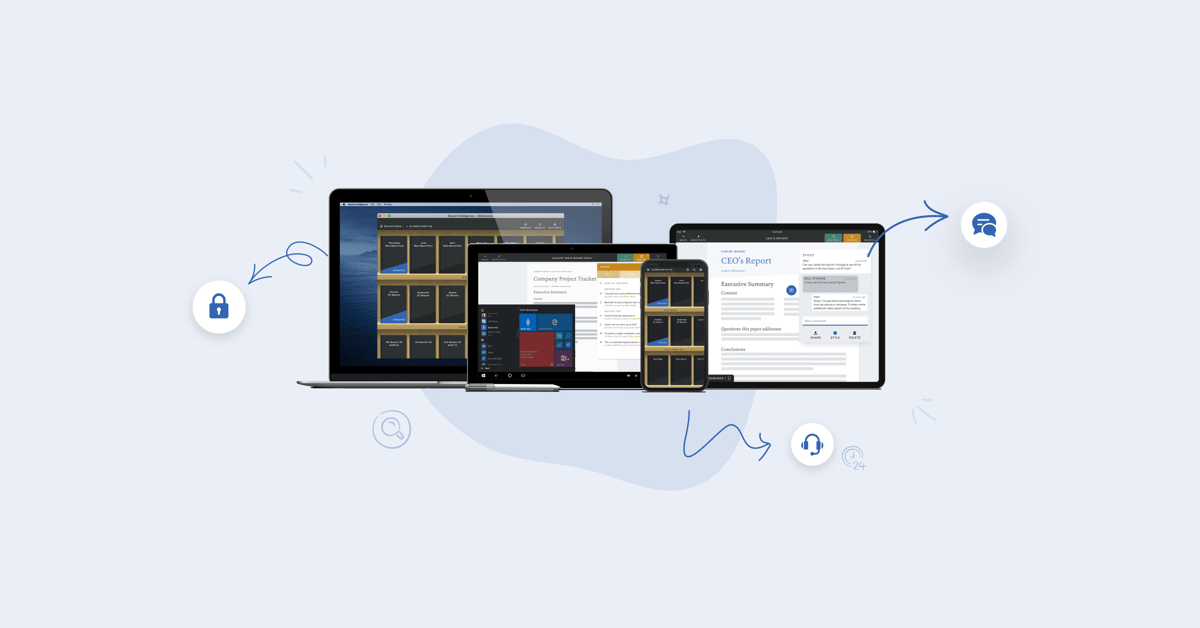
From Waystone through to Apex and Ocorian, the world’s largest fund, trust, and corporate service providers use Board Intelligence to deliver a superior service to their clients. Here are the four key reasons they, and 12,000 users from the fund service community, use our board management technology:
If you administer board meetings for many client entities, your board portal needs to do four things. It must save your team time and cost, and keep each client’s data separate. It must give your clients’ directors a reliable experience, and move across from your current provider with minimal disruption. Below, we set out how Board Intelligence does each one, and what to test before you switch.
Why do fund service providers switch board portals?
1. It saves time and cost internally, whilst increasing client spend
Fund service providers are under pressure to do more with less. So, our board portal is optimised to deliver efficiency gains that save time and cost. Apex Group’s teams, working across more than 20 countries, produce board packs 40 to 60% more efficiently than they did before they switched.
With Board Intelligence, you can create agendas, brief report writers, upload files, and publish packs from one administrator interface, which removes the rebuild work at the start of every cycle. And our permission system lets you make last-minute changes yourself, whether that’s adding or removing users, reordering the agenda, or slotting in a late paper, so a change that would otherwise sit in an external help desk queue takes effect when you make it.
We’re looking at a 20 to 25% time-saving in creating the board packs compared to our old board portal provider.”
Adam Jeffries, Group CIO, JTC
And it’s not just cost savings that Board Intelligence brings: one of our recent fund service partners reported an overall client spend increase of 7% after incorporating our portal into their services portfolio.
Apex Group shows what this looks like at scale. Board Intelligence supports 540 of Apex Group’s clients across more than 20 countries. Its company secretarial teams have taken on more board meetings without a matching increase in headcount. Read the case study.
2. Its design is tailored to fund service providers’ specific needs
Board portals are typically built around a single organisation: one board, one set of directors, one document library. Fund, trust, and corporate service providers work differently, with many client entities, many boards, and strict separation between them. Our board portal is built for that structure.
Board Intelligence’s portal is clearly built to suit the needs of fund services teams.”
Wendy Twamley, Senior Director, Internal Corporate Secretarial Services
Our bookcase and bookshelf structure segregates your clients’ data, keeping everything separate, simple, and secure, while giving you one view of every entity you administer. Permissions run down to the individual document, so an administrator or a client director sees only the entities, packs, and papers they’re cleared for. We also separate junior and senior administrator roles: a junior administrator can collate a pack but cannot publish it, so a second person approves what reaches the board.
Test that separation yourself before you commit, and read our guide to secure board software for the questions to put to every vendor.
3. It offers fund service providers’ clients a premium experience
One of our fund service partners described their board portal as their “shop window”. So it matters that their clients’ directors have the best possible experience. That comes down to four things: fast search, easy collaboration, secure data, and support whenever they need it.
Ocorian’s IT leadership compared our support against their other global vendors:
BI24 are amazing. Without fail, every time we need something, they are the most responsive support team I deal with across all of our vendors globally.”
Stuart Geddes, Group Head of IT, Ocorian
With Board Intelligence, your clients can:
- Search across and within packs to find what they need, whether it is from two weeks or two years ago, and whether they are on the go or off the grid.
- Annotate packs and use in-app chat ahead of the meeting, so a director raises a question on a paper and the author answers it before anyone sits down.
- Rely on data hosted in UK data centres and certified to ISO 27001 for information security, and on remote wipe if a director loses an iPad or another device.
- Speak to our BI24 team, who are on hand at all hours, 365 days a year, with any technical questions.
4. Switching is fully supported
Our implementation team manages the switch for you. For service providers, that means roll-outs of more than 100 entities a month, all handled by the Board Intelligence team. Our onboarding specialists support you at every step, migrating your materials, setting up templates, and training your directors.
Here is what you can expect:
- First, we will help you build a business case setting out the projected time and cost savings, and where possible, new revenue streams.
- Second, we will map out a migration and onboarding plan, and assign you a dedicated account manager to oversee the switch programme.
- Third, we will shape the charging model around the time left on your existing contract, so you can avoid paying twice for the same period. The structure depends on your contract terms and the migration timetable, and we will set it out in writing before you commit.
What should fund administrators test before switching board portals?
Test ten things before you switch: entity separation, delegated administration, permission inheritance, bulk user management, branding, pack workflows, audit exports, data migration, client onboarding, and support response. Run each test across at least two contrasting client entities and one late-paper scenario. Record the result as pass, failure, or workaround, and name an owner for each. A general ease-of-switch claim from any vendor, ours included, is no substitute for that record.
Test multi-entity separation and administration
Test ten things before you switch: entity separation, delegated administration, permission inheritance, bulk user management, branding, pack workflows, audit exports, data migration, client onboarding, and support response. Run each test across at least two contrasting client entities and one late-paper scenario. Record the result as pass, failure, or workaround, and name an owner for each. A general ease-of-switch claim from any vendor, ours included, is no substitute for that record.
Rehearse data and user migration
Migrate a real historic pack, not a sample file, and check that the document structure, the meeting dates, and the permission sets arrive intact. Bulk-load a user list and confirm inherited permissions land where you expect.
Test client onboarding and late changes
Onboard a director as a new client user and time how long it takes them to find a paper from a previous meeting unaided. Then add a late paper an hour before a test meeting and confirm you can publish it yourself without raising a ticket.
Record failure, workaround, and ownership
For every test, write down what happened, whether a workaround exists, who owns the fix, and what it costs you at migration if it stays unresolved. That record is what turns a vendor demonstration into a decision you can defend.

With the “easiest to use board portal on the market”, powered by enterprise-grade security, first-rate support, and features that set your board and governance team up to succeed.
Book a demonstration