Ask any board director whether AI is on their agenda, and the answer will be yes. Ask whether their board is genuinely equipped to govern it, and the picture gets more complicated.
Boards' AI readiness is what we set out to understand when we launched the Board AI Readiness Radar. Developed in partnership with technology disruption experts Paradigm Junction, this free online tool assesses the extent to which a board's frameworks, practices, and processes have been adapted for the AI age. In just a few minutes, you'll get a clearer view of where your board stands today and the opportunities to improve board oversight and resilience in an AI-powered world.
Six months on from the launch, we've crunched the data and it reveals some fascinating insights — about what boards are doing well, where they're falling behind, and what can be done to help them get up the AI curve faster.
At a glance: the findings so far
So far, the data — which spans 31 organisations and 11 countries — tells a consistent story: that, when it comes to AI, there's a significant gap between board awareness and board preparedness. Only 10% of boards have recorded an overall score that could be considered "AI ready"*.
To some extent, this gap may be inevitable, given AI is a relatively recent addition to the board agenda and most board members are not technologists by background. But it has consequences, not just for risk oversight, but also for capital allocation, innovation, and long-term value creation, and it'll prove dangerous if it persists.
The boards who do close it will be better placed to lead their organisations through this period of deep and rapid change.
* Those scoring 20/30 or more are considered "AI-ready"

What the data tells us about board AI readiness
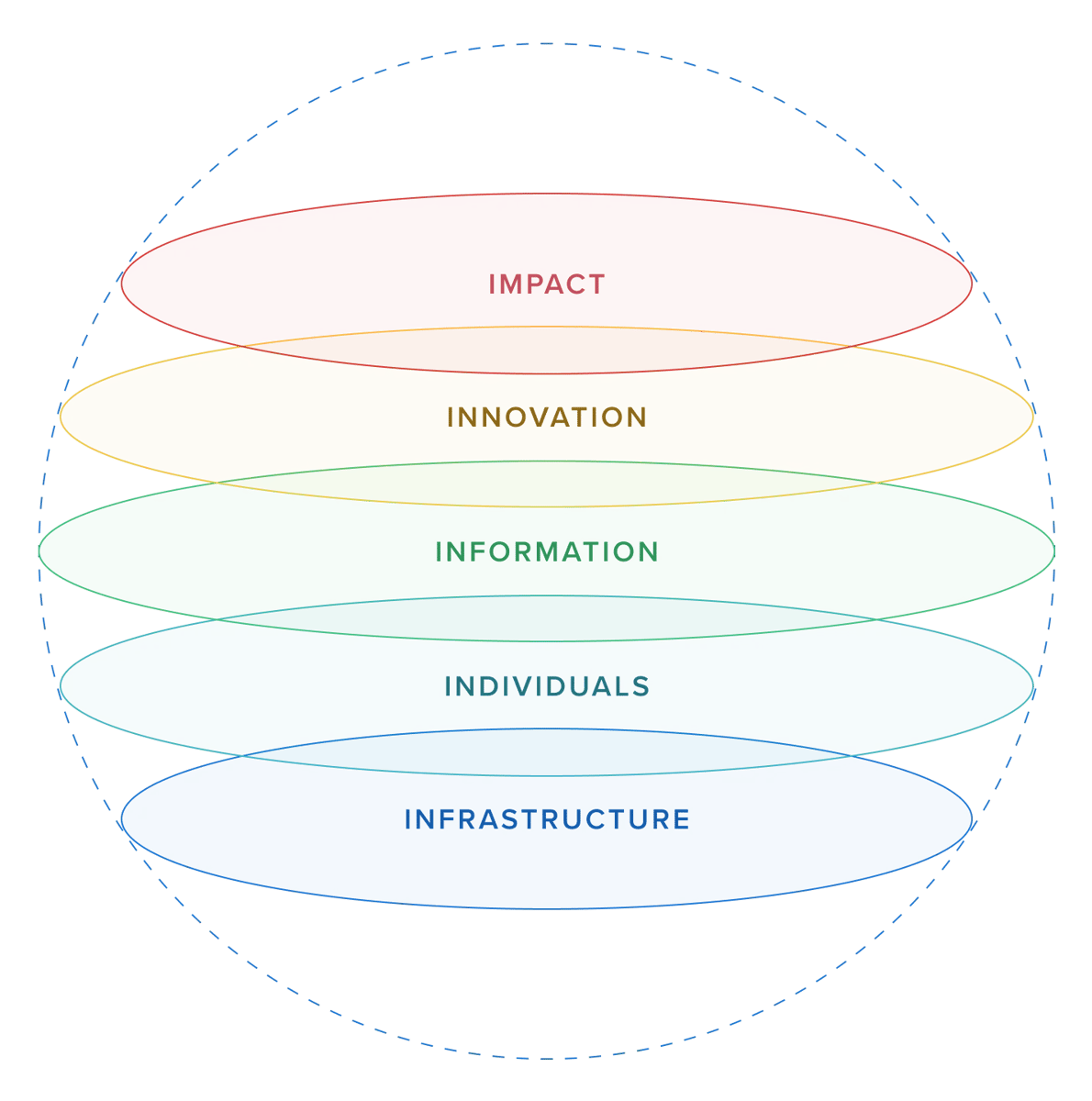
The Board AI Readiness Radar asks respondents to answer 15 questions grouped around the five pillars of board effectiveness (also known as the "5 I's of board effectiveness") — Individuals, Infrastructure, Information, Innovation, and Impact. Each response receives a score: 0 points for "No", 1 point for "Sometimes", or 2 points for "Yes".
The average score across all respondents is just 10 out of a maximum of 30 points, and the most common score is even lower, at just 6 out of 30.
Only 10% of boards recorded an overall score of 20 or more — the threshold we'd consider genuinely "AI ready". And across all 15 questions, only 11.4% of the answers were "Yes".
What's more, in both Impact and Infrastructure — two of the five pillars — a significant cluster of boards have made little or no progress at all.
The picture is also skewed by a small number of high-scoring organisations pulling the average up. Strip those out, and the results look more sobering still.
|
Overall score (max. 30) |
2025 |
2026 |
All responses |
|
Mean score |
9.3 |
11.4 |
10.0 |
|
Median score |
8 |
9 |
8 |
|
Most common score (mode) |
6 |
7 |
6 |
Where boards are most — and least — prepared
The 5 I's framework maps the conditions that enable boards to be genuinely effective: when boards have the right individuals, infrastructure, and information in place, play an active role in building a culture of innovation, and have a clear understanding of their impact.
The AI Readiness Radar asks whether each of those conditions is in place specifically for the challenge of governing AI — recognising that AI's disruptive potential and rapid pace of development present new risks and opportunities that may need fresh approaches, processes, and frameworks for boards to govern effectively.
Looking at the scores by pillar, the picture is more varied than the headline numbers suggest.

Infrastructure appears to be where there are the most significant gaps. In all three questions — whether risk frameworks are evolving to reflect AI, whether processes support timely AI-related decision-making, and whether roles and responsibilities are clearly defined around AI — the most common score is zero. These are not peripheral concerns. They are the structural conditions that underpin the board's effectiveness.
Information follows closely. Boards score lowest here on average (1.7 out of 6). The three questions we asked about information explore whether boards are equipped with the right information to oversee AI-related decisions, whether they're measuring the right things, and whether they're looking outward to understand AI developments. All three are scoring zero, or very close to it – essentially, a resounding "No".
This aligns with what seven years of joint research by Board Intelligence and the Chartered Governance Institute tells us about the state of board reporting more broadly. Despite rising expectations, the quality of board information has barely improved. Papers remain backward-looking, data-heavy, and disconnected from strategic priorities. Layering AI oversight on top of reporting infrastructure that was already struggling is a significant ask.
Innovation appears more promising — it's the highest-scoring pillar on average (2.6 out of 6). But dig into the individual questions and the picture is more mixed. Boards score reasonably well on 'supporting a culture of learning and innovation' (average 1.3 out of 2). They score much less well on whether they're proactively using technology to improve how they work themselves (0.7) or whether there's an AI governance framework to support responsible experimentation and deployment (0.5).
The Board Value Index, which draws on data from more than 200 board members in the UK and North America, found that board development activity around AI and digital capability was consistently identified as the area where investment would add greatest value. Data from the Board AI Readiness Radar reinforces this: individual capability building is one of the three lowest-scoring questions across the entire tool, with a mode of zero.

Four practical steps to close the AI readiness gap
It would be easy to read these findings and despair. We don't think that's necessary. The boards doing this well tend to share some common characteristics — and the distance between where most boards are today and where they need to be is not insurmountable.
A few things stand out from the data:
1. Start with individuals before governance
Boards that score well on capability (understanding AI, asking good questions, engaging constructively with management on AI matters) tend to build more effective governance structures. The reverse is rarely true. A risk framework designed by a board that doesn't understand what it is governing is not a safeguard — it's a formality.
2. Demand better information from management
Boards can't govern what they can't see. That means expecting management to provide AI-specific insight — not just general technology updates — and to connect it to organisational strategy, risk appetite, and performance outcomes. Company secretaries and governance professionals have a critical role here in shaping what gets on the agenda and in what form.
3. Integrate AI into existing frameworks rather than building in parallel
One of the most common mistakes is treating AI governance as something separate — a new committee, a new policy, a new line item in the risk register. The boards doing this best are integrating AI considerations into existing decision-making structures, risk frameworks, and reporting cycles.
4. Use AI yourselves
Directors who experiment with AI tools — carefully, thoughtfully — tend to engage with AI governance questions more effectively. You cannot ask smart questions about something you've never encountered. The boards scoring well on the Innovation pillar are disproportionately the ones where directors are using technology to support their own work.
AI readiness is improving — but are boards moving fast enough?
Here's the encouraging part: the gap is closing.
Although our sample size is currently small, year-on-year, scores appear to be improving. The mean score for organisations that have completed the Radar so far in 2026 (11.4) is meaningfully higher than those who completed it in 2025 (9.3). The median and mode have both shifted upward. It's a signal that boards are waking up to the challenge and the opportunity of AI — and those that have started the journey are making measurable progress.
The question is whether the pace is fast enough. AI capabilities are not waiting for governance frameworks to catch up. The organisations that treat this as a long-term change programme — rather than a periodical risk review — are the ones that will build durable oversight capability.
As Helle Bank Jorgensen, Global Managing Director of Board Development at Board Intelligence, puts it: "Boards have a responsibility to ensure that technology adoption, especially AI, is accompanied by clarity, capability-building, and fairness. That includes oversight of how decisions are made, how people are reskilled, how transparency is maintained, and how trust is preserved."
Getting the right support and tools for the transition ahead
For boards to govern AI effectively, governance teams need to raise the quality of the information that reaches the boardroom. That means papers that are decision-ready, insight-led, and connected to the organisation's long-term strategy and goals.
It also needs directors who can engage critically with those papers, by asking better questions, spotting gaps, and challenging assumptions. Directors who are proactively developing and deepening their understanding of the topic through structured development and responsible experimentation.
This is exactly the problem that purpose-built governance AI — AI trained on the science of board effectiveness, not adapted from general-purpose consumer tools — is designed to solve.
Take Report Writer, for example. It helps governance teams and management produce better board papers faster: structured, concise, and focused on the decisions that matter. Or Insight Driver, which helps directors get more from board packs — surfacing the questions worth asking, identifying gaps in the information presented, and enabling more productive challenge.
Neither is a shortcut. Both are designed to make the work of governing more rigorous — not less. And both are built on two decades of boardroom expertise, by a governance partner you can trust.
If you'd like to see where your board stands, the Board AI Readiness Radar is free to use and takes less than ten minutes to complete. You'll get a score across all five pillars, and a clearer view of where to focus next.
About the data
The Board AI Readiness Radar was developed by Board Intelligence in partnership with Paradigm Junction. Data in this article is drawn from 31 organisations across 11 countries (including the UK and Canada), collected between October 2025 and February 2026.
With Insight Driver, surface the questions worth asking, the stakeholders worth considering, and the context worth knowing.
See Insight driver