Every organisation is becoming a technology-enabled one, and AI is changing what those organisations can do in hours rather than years. Seventy-six boards have now told us how well equipped they are to govern at that speed. Most are encouraging their organisations to experiment faster than they are deciding who answers for it, and half of all directors say their board lacks the information to oversee those decisions at all. Not one of those boards has reached the level we call AI ready. Being AI ready means more than having a policy. It means directors getting better information, setting rules their teams can work inside, and knowing who answers when something goes wrong.
What the Board AI Readiness Radar measures
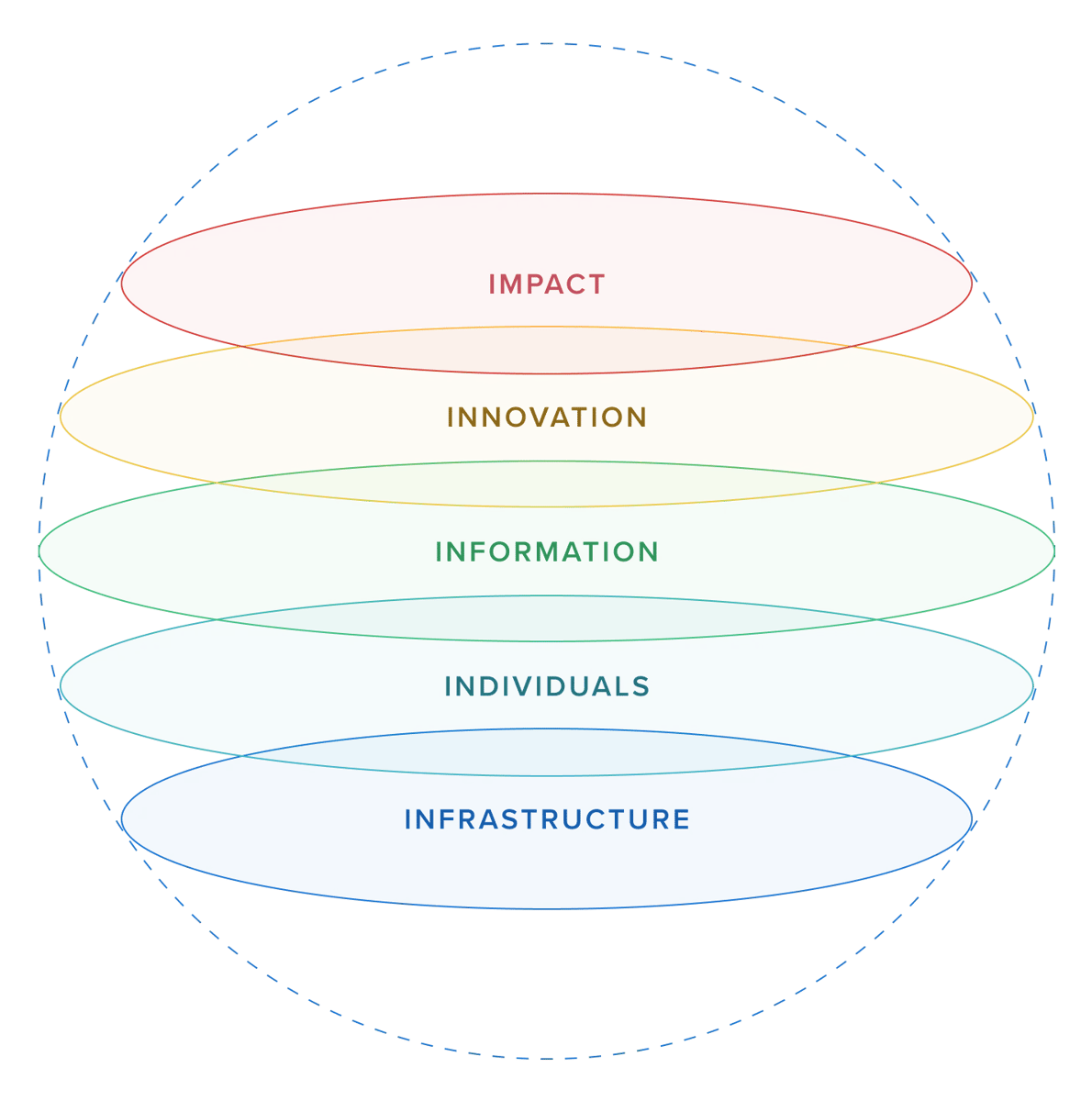
We launched the Board AI Readiness Radar in October 2025, developed in partnership with technology disruption experts Paradigm Junction. It asks respondents to answer 15 questions grouped around the five pillars of board effectiveness, also known as the 5 I’s of board effectiveness: Individuals, Infrastructure, Information, Innovation, and Impact. Each response receives a score: 0 points for “No”, 1 point for “Sometimes”, or 2 points for “Yes”.
We consider 20 out of 30 as the point at which a board can be called “AI ready”. Directors on a board at that level have answered yes or sometimes to nearly every question, which means that board has at least part of what it needs to oversee AI.
Where boards stand on AI readiness today
The average board scores 11.9 out of 30, which is a board answering “sometimes” to most of the Radar’s questions and “no” to many of them. Eleven boards, 14% of the sample, scored 20 or more.

Across all 76 boards and all 15 questions, directors were most likely to answer “sometimes”, at 44%, followed by “no” at 38%, and “yes” at 18%. Most boards have some of the conditions for AI readiness, and few have all of them.
Where boards are most — and least — prepared
The 5 I’s framework maps the conditions that enable boards to be effective: when boards have the right individuals, infrastructure, and information in place, play an active role in building a culture of innovation, and have a clear understanding of their impact.
The AI Readiness Radar asks whether each of those conditions is in place specifically for the challenge of governing AI — recognising that AI’s disruptive potential and rapid pace of development present new risks and opportunities that may need fresh approaches, processes, and frameworks for boards to govern effectively.
Looking at the scores by pillar, the picture is more varied than the headline numbers suggest.

Directors score highest on Innovation. We ask whether the board supports a culture of learning and innovation, whether directors proactively use technology to improve how they work themselves, and whether the organisation has an AI governance framework to support responsible experimentation and deployment.
Directors score lowest on Infrastructure and Information. On Infrastructure, we ask whether risk frameworks are evolving to reflect AI, whether processes support timely AI-related decision-making, and whether roles and responsibilities are clearly defined around AI. On Information, we ask whether directors have the right information to oversee AI decisions, whether the board measures the right things, and whether directors look outward to understand AI developments.
The questions directors answer no to most often show where their boards have adapted least. Six of the Radar’s 15 questions drew a no from close to half of directors or more. More than half, 53%, say their board does not measure the right things on AI, and half say it lacks the information to oversee AI decisions. Between 46% and 49% say the same about clarity of roles and mandates, about board processes for AI decisions, about the chair’s leadership, and about whether their organisation has an AI governance framework.

Four of those six questions sit in Infrastructure and Information. Directors on those boards take AI decisions without clear ownership of them, without the information to judge them, and without a measure of whether they worked.
Directors told us something similar in the Board Value Index Summer 2026, where 84% of directors, CEOs, and CFOs said poor information quality had caused their board to make at least one delayed, rushed, or poor decision in the preceding six months. Another 78% said the same of board members’ skills and subject matter expertise.
Nearly half of boards, 46%, scored zero on a whole pillar, which means their directors answered no to all three of its questions. Infrastructure is where this happens most, at 25%, followed by Information at 22%. Directors on those boards have nothing at all in place in that pillar.
Directors completing the Radar this year score higher than those who completed it last year. Boards averaged 10.3 out of 30 during 2025 and 12.5 during 2026.
Higher scores are encouraging but being better prepared than last year does not necessarily mean keeping pace with AI, which has also evolved rapidly in the last 12 months.”
James Hutt, Founding Director, Paradigm Junction
James Hutt, Founding Director at Paradigm Junction, added that Boards need to turn their encouragement of experimentation into practical support, so teams know what they can try, who is responsible and how to share what they learn. He said that gives directors a way to keep updating their decisions as the technology and its uses change.
Chairs who lead on AI set their boards up to plan ahead
Only 13% of directors said their chair models effective leadership on AI. Nearly half, 46%, said the chair does not.
The Radar asks directors three things about that leadership. Does the chair set the tone by initiating conversations on AI before major developments occur, and by raising risks and opportunities before they escalate? Does the chair help the board engage with external perspectives and emerging thinking, by inviting external speakers for example? Are the board’s priorities on AI clear, and reflected in how the chair leads?
Among directors who answered yes, 40% said their board is actively shaping the organisation’s plan for adapting to AI over the next two to three years. Among directors who answered no, 9% said the same.
Chairs decide how the board spends its time. In the Summer 2026 edition of the Board Value Index, 51% of UK directors said their board spends half or more of its meeting time reviewing past performance, against 41% globally. Directors on those boards have little room left to guide their organisation through a multi-year AI plan, and the chair is the person who makes that room.
Liselotte Engstam, Chair, Boards Impact Forum, describes what a board falls back on without that time. “Boards have plenty of processes to support their supervisory role. They don’t have nearly as many processes to help them in their guiding role. And many of the advisors to boards advise primarily on the supervision side — on what might be going wrong. It’s very easy for a board to end up thinking: at least I won’t do wrong. But that isn’t enough.”
Boards encourage experimentation without setting the rules for it
Directors answer yes more often than no on one question only, which asks whether the board supports a culture of learning and innovation. Of those directors, 39% answered yes and 9% answered no. On the other 14 questions, no responses outnumber yes responses every time.
Directors answering yes are telling us that their board reviews give them actionable insight on the board’s ability to foster AI-led innovation, that the board proactively assesses and measures the organisation’s culture, and that executive incentives and performance assessments encourage learning, adaptation, rapid experimentation, and learning from failure.
Far fewer of those directors have put a framework behind that encouragement. Among the boards that support a culture of learning and innovation, 47% said their organisation has no AI governance framework covering responsible experimentation and deployment, and a further 27% said one is only partly in place. So roughly three-quarters of the boards encouraging their people to experiment with AI have not set the guardrails behind it. Directors on those boards have not adapted their oversight structures to support experimentation and have not made clear who holds accountability for it.
Teams whose boards tell them to experiment with no framework around it have to work out for themselves what they can try, what data they can put into a tool, and who they tell when something goes wrong. Boards can take that guesswork away by setting out what people may try, what limits apply, and how the board hears what was learned.
One of the most common mistakes is treating AI governance as something separate — a new committee, a new policy, a new line item in the risk register. The boards doing this best are integrating AI considerations into existing decision-making structures, risk frameworks, and reporting cycles.
Boards update their frameworks before agreeing who is responsible for AI
More than one in five directors, 22%, said their board is evolving its risk frameworks and governance structures to reflect AI. Among those boards, only 24% also said roles, responsibilities, and mandates on AI are clear. The other 76% said that clarity is partial or missing. Directors are updating their risk frameworks and governance structures faster than they are agreeing who is responsible for AI, who holds the mandate, and who answers for it.
Directors can see where their own board stands by picking one AI decision the organisation is taking this quarter and tracing its route. Which paper brought it to a governance forum first, and who wrote it? Who approved the spend, and under what delegated authority? Which committee holds oversight once the tool is live, and how often does it look? What would have to go wrong before someone escalated it to the board, and who makes that call?
Directors who can answer all four have the clarity the Radar asks about. Directors who cannot have found the gap, and the gap is usually the same one. Someone approved the decision and nobody owns what happens next. Fixing it means naming the committee, writing down the delegated authority, and setting the trigger for escalation before the board needs it.
Three things you can do now to improve board readiness
Directors need more than good papers to govern AI. They can make progress in three places, and each one answers something the Radar shows boards are missing. For boards scoring zero on a whole pillar, the way in is to pick one question in each pillar to work on this year and build from there.
1. Raise the standard of the information
Half of all directors said their board lacks the information it needs to oversee AI decisions, and not one of those boards scored 20 or more. No board in our data has reached AI readiness while its directors are working from the wrong information.
Directors have been telling us this for years, and AI has not created the problem. Board Intelligence and the Chartered Governance Institute UK & Ireland have tracked this together for eight years. Board members and governance teams tell us the quality of board papers has barely improved, while packs have grown longer and stayed backward-looking. You can read what directors told us about the papers they receive in the state of board reporting, and how boards are using AI to improve them in our guide to AI for the board pack.
Better papers start with the board. Directors write their own list of what they need to know about AI, because a board that asks management to decide that gets an update on the tools in use and the risks on the register. Those questions then belong in every paper that comes to the board. Papers on strategy should say how AI changes the way the organisation creates value. Papers on investment should say what it costs and what the return looks like. Papers on people should say which roles change. A single paper labelled AI, sitting on its own in the pack, is a sign the board has not asked the question properly.
Directors also shorten the periods they measure over. Assessing an experiment or a return on investment across a full annual cycle means reviewing results that the pace of change has already overtaken, so set the timeframes to match how fast the technology moves. Test all of this against the last AI item that came to your board. Which decision was it meant to inform? What measure can the board return to next time? An item that answers neither is a technology update.
Governance teams then have to answer those questions on the page. The QDI Principle, short for Question-Driven Insight, is Board Intelligence’s method for doing that, built on work with more than 3,000 organisations. Teams who adopt it think critically, communicate with impact, and focus on what matters.
The QDI Principle is built into Report Writer, Board Intelligence’s AI-powered report writing tool for governance teams and management. It turns notes, data, or documents into a structured first draft that answers the questions decision-makers need answered, then highlights what is working, what is not, and what to do about it. The AI behind it is built on 20 years of governance consulting expertise.
2. Give directors tools they can use on the pack
Directors govern AI and use it at the same time, and using it in their own work is one of the fastest ways to learn what it does well and where it fails.
Boards whose directors use new technology in their own work score higher on every pillar. Where directors answered yes to that question, their boards averaged 19.6 out of 30. Where they answered sometimes, the average was 13, and where they answered no, 7. Not one board whose directors answered no scored 20 or more. Boards split more sharply on this question than on any other. For a practical starting point, see how high-performing directors prepare for board meetings with AI.
Two tools inside Board Intelligence’s board portal support that work.
Directors get more from the pack in front of them with IQ Insights, Board Intelligence’s AI-powered meeting preparation tool. It surfaces the key points and asks from any paper, links matters to past discussions, and flags what deserves a closer look, including light rationale, missing context, and forgotten stakeholders.
With IQ Experts, Board Intelligence’s AI built to make boards more effective, directors analyse what a paper says and what it leaves out, inside the same secure portal. It brings expert perspectives and boardroom capabilities to any paper, from cybersecurity risk and capital allocation to CEO succession and ESG expectations, and it searches live external sources. Every answer cites its source, and the director forms their own view.
3. Upskill the board
The rest comes from structured development, so directors build their understanding alongside the hands-on experience. Board Intelligence works with boards directly through board development and board evaluation, and the Future Boardroom Experience gives directors a setting to experiment with AI tools while they learn how to govern them.
If you would like to see where your board stands, the Board AI Readiness Radar is free and takes under ten minutes. You will get a score across all five pillars and a view of where to focus next.
The Board AI Readiness Radar was developed by Board Intelligence in partnership with Paradigm Junction. The data in this article comes from 76 submissions from 19 countries, including the UK and the UAE, collected between October 2025 and November 2026. Where a respondent submitted more than once, we have counted their first submission only.
FAQs
-
What is the Board AI Readiness Radar?
The Board AI Readiness Radar is a free self-assessment from Board Intelligence, developed in partnership with Paradigm Junction, that scores how well equipped a board is to govern AI. Directors answer 15 questions grouped into five areas of board effectiveness: individuals, infrastructure, information, innovation, and impact. Each answer scores 0 for no, 1 for sometimes, and 2 for yes, giving a maximum of 30. It takes under ten minutes.
-
What counts as an AI-ready board?
A board is AI ready when it scores 20 or more out of 30 on the Board AI Readiness Radar. Directors on a board at that level have answered yes or sometimes to nearly every question. Across 76 boards assessed between October 2025 and November 2026, 11 boards reached it, or 14%. The average score is 11.9.
-
Where are boards least prepared for the AI age?
Boards are weakest on the infrastructure behind AI decisions and the information directors receive, averaging 2.2 and 2.1 out of 6. More than half of directors, 53%, say their board does not measure the right things on AI, and half say it lacks the information to oversee AI decisions. No board in that second group has reached AI readiness.
-
Are boards getting better at governing AI?
Scores are rising. Boards completing the Radar during 2025 averaged 10.3 out of 30, and boards completing it during 2026 averaged 12.5. AI has moved quickly over the same period, so a higher score does not on its own mean a board is keeping pace with the technology it oversees.
With Insight Driver, surface the questions worth asking, the stakeholders worth considering, and the context worth knowing.
See Insight driver