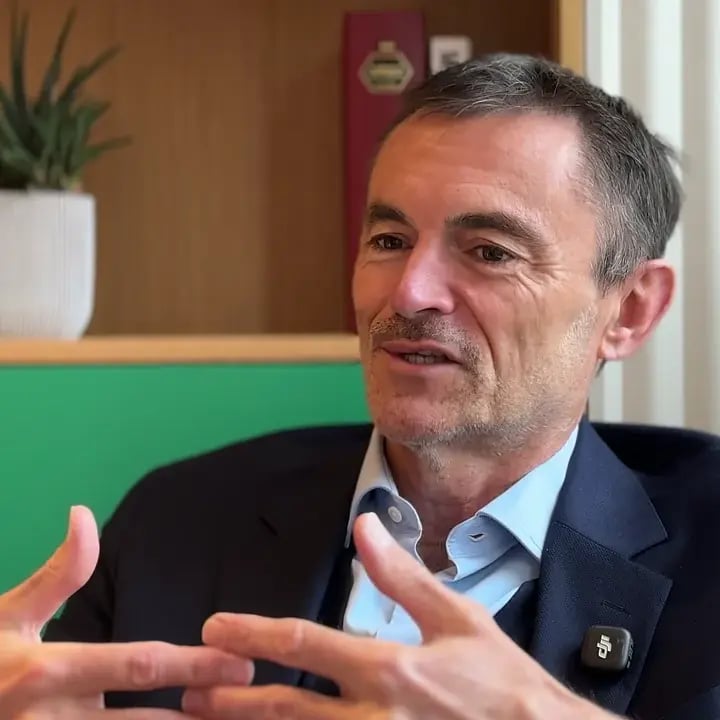
Nick Hampton has run Tate & Lyle since 2018 and sits on the boards of Severn Trent and Prostate Cancer UK. He spoke to Emma Priestley about constructive conflict in the boardroom, how his teams are testing AI, and the product launch he pushed through alone.
My business
Q: Tate & Lyle is one of the longest-standing, most established members of the London Stock Exchange. It’s the only founding constituent of the FT 30 back in 1935 that is still listed. How would you describe the company and its importance today?
A: It’s completely transformed. It started as a sugar company and now we don’t sell sugar. A lot of what we do today is about replacing sugar. We’re reformulating food to improve its nutritional content to make tasty food healthier and healthy food tastier. We’re having a fundamental impact on reducing sugar, calories and fat — and adding fibre to people’s diets. Over the last 10 years we’ve taken trillions of calories out of the diets of the world.
Now with the rise of GLP-1s and other weight-loss drugs, we’re investing more to help customers increase nutritional density in their products with extra protein and more fibre for gut health.
Q: How important is it that Tate & Lyle is not only profitable and makes money for shareholders, but also tries to have a positive role for consumers and society?
A: Whilst the company’s focus has changed, what is true today was true 165 years ago: that we’re a purpose-driven company.
Purpose is about doing good business, and good business is about making money. You can’t have purpose if you don’t make money because you can’t invest. Our purpose is what makes us a stable corporation: consumers want companies to help to solve problems, and employees believe in this too.
My leadership
Q: You’ve sat on both sides of the table as chief executive and an independent director. When you approach a board meeting, in whatever capacity, what are you always looking to get out of it?
A: As the chief executive or as a director, you hope you’re really addressing the fundamental strategic issues facing the business. You’re assembling this incredible experience base, and you want to tap into their experience. As a CEO you want to get an outside-in perspective. You want board directors to challenge you to create a better outcome for the company and all of its key stakeholders. And as for non-executive directors, you shouldn’t join a board if you don’t believe in the company, in what it’s trying to do, or if you don’t believe you can help.
Of course, the board’s real value is in its ability to question: is the strategic direction of the company sound? Is the strategy being well executed? And does the leadership team have its eyes on the right issues?
Q: Do you encourage robust exchanges on both sides of the boardroom table?
A: Absolutely, and if you don’t want that, you shouldn’t be in the room. Conflict is inherently uncomfortable, but constructive conflict is good, and there’s a way of doing it that allows relationships to build and for people to trust each other.
Q: How does a good modern forward-facing company look at AI?
A: I’m certainly not a digital native but I try to learn from the best.
We’re running a number of experiments, we call them use cases, in areas where we think AI can really make a difference in our business. For example, we’re looking at how to accelerate the development process and to catalogue all of our ingredients and recipes. We’re using AI in the supply chain and that can really drive efficiency.
We’re also experimenting in how we use AI to make our employee experience better. We want to use AI to accelerate the information gathering process so employees can turn information into knowledge into action. But we want to do that in a very focused way and learn as we go, rather than throwing massive amounts of money at it too quickly.
Q: Are you an AI optimist, or do you think we’re all going to die next Tuesday?
A: I’m inherently an optimist, but I’d be lying if I said I know enough about AI to know whether that’s right or wrong. The human race has this incredible ability to adapt, we’re incredibly resilient. People smarter than me will figure this out, but I think the fear that AI is going to kill work is nonsense. It’s more that work will evolve and be different. One massive positive of AI is it will increase the amount of time spent on the value add, which is about shaping the future of the business.
Q: Looking ahead to the next 10 years in the boardroom, how do you see things changing?
A: The pace of change in the world isn’t going to slow down. We’ll increasingly be talking about different versions of the future, rather than one version. The days of a board talking about a five-year plan with a point forecast will have gone, and we’ll be talking about a range of plausible outcomes for the business to try and chart a pathway forward. That will require more resilience, more agility and more optionality. The board decisions in 10 years’ time will be more complex than they are today.
Q: As the world changes faster than ever, does the make-up of boards need to change?
A: I argue for creating a board with an even greater level of diversity than we have today. We had a conference of our 80 top leaders last week, and one of the most tenured of our leaders stood up and said: “When I joined the company 25 years ago, I went to a meeting like this. There were only two women.” In the room last week, we were gender balanced. Twenty-five years ago, they were all from the western world, and if you looked at the room last week, it was multi-ethnic with local leaders from all around the world. The nature and diversity of business is changing massively already, and boardrooms will reflect that going forward.
My work life
Q: You are CEO of Tate & Lyle, sit on the board of Severn Trent and serve on the board of the Prostate Cancer UK charity. How do you do it all plus family?
A: I’m relentlessly driven. I can’t sit still for more than five minutes. So, having all of those things is a joy because it’s incredibly stimulating to work in different environments with great people. Prostate Cancer UK is an amazing charity. They’ve got brilliant people. It’s an amazing board. And I’m biased but Severn Trent is the best water company in the country, with an amazing management team and board.
For me, it’s about picking the organisations you really want to work with because you believe in the people and you believe in what they’re doing. What’s more important or more fundamental than the right to water? What’s more fundamental to the well-being of the male population than solving prostate cancer? It’s the most prevalent cancer in men in this country. There are over half a million of us living with it today.
Q: Have you thought differently about your performance in business, and how diet and exercise can help you do a better job?
A: As I’ve gotten older, I’ve become more conscious of the need to take care of myself. Exercise has always been my pressure relief. I’m an obsessive runner. But I now do Pilates because my bones creak as I get older. Running is time away to think. A healthy body leads to a healthy mind.
That said, I’ve got a huge weakness for salty snacks because I spent 20 years working for PepsiCo. I built the biggest crisp factory in the world in Leicester. My kids used to call me the “chief crisp maker”. Walkers crisps, I love them.
My lessons
Q: Is there something in your career that you look back on and tear your hair out?
A: Because I was growing up fast in business, going through consulting, and then into PepsiCo, I was always the youngest person in the room. That triggered this anxiety that I had to have the best answer all the time. People found that intimidating. In retrospect, I wish I’d realised the power of engaging people and taking people on a journey, and really, building this sort of collective belief in what you’re doing. If I’d done that, my first 20 years in business would have been a lot less painful.
There were lots of decisions that I was trying to get through that didn’t happen as a result. For example, when I was in the Walkers crisps business, we were contemplating launching a Kettles-type product — a crisp with a harder crunch. We had a new technology that we were developing that wasn’t perfect, but I was convinced that we needed to launch. The problem is I was so convinced that it was the right decision, that I didn’t focus enough on taking people on that journey with me, laying it out in a way that was compelling for people. I failed to get the organisation aligned behind the decision to launch, and because of this, we ceded the category.
Nick Hampton spoke to Emma Priestley for What matters in the boardroom, our interview series with the chairs, chief executives, and directors who sit in them.
Register for our newsletter to get a monthly compilation of our latest chair interviews, governance research, and upcoming webinars and events, along with weekly round-ups of the top news that matter to board members.
Register Now