Entity records are a governance exposure that sits closer to the board than most groups assume.
The reason is structural. Directors are accountable for governance across the whole group, including every subsidiary they've never looked at in detail. They rely on the governance team to surface entity-level information when a question arrives. If that team can't produce a verified, current answer quickly, the board's accountability is resting on data nobody can stand behind on demand. Since the Economic Crime and Corporate Transparency Act 2023 (ECCTA) began tightening what Companies House expects UK groups to confirm and evidence, the window for producing that answer has narrowed.
The risk is that nobody can produce one verified answer at the speed a bank, regulator, or auditor now expects.
What does fragmented entity data mean?
Fragmented entity data means the record of who owns what, who directs what, and where each entity is registered exists in several places at once, with no single version anyone can name as authoritative.
From the inside, this rarely looks like a failure. Someone entered each record correctly, or it was accurate the last time anyone checked it, and governance teams usually know where most things sit, in a shared drive, a colleague's inbox, or a spreadsheet someone updates from memory. The strain surfaces when someone answers a question that spans several entities, or when they have to show the source behind an answer to a bank, an auditor, or a regulator.
Ownership records split across spreadsheets, shared drives, and legacy systems
Structure builds up as a group grows, and governance teams end up carrying most of it by hand. Someone builds a spreadsheet to track shareholdings during an acquisition. A regional team keeps its own version because the corporate one lags behind local filings. Finance still relies on a legacy system, inherited through a merger, for the only complete history of a dozen dormant companies, and only one person there knows how to query it.
Governance professionals build these workarounds to keep the group running while its systems lag behind its growth. They pay for it later. A director asks who owns a particular subsidiary and in what proportion, and the governance team reconciles three sources before answering, doing that work without writing any of it down, so nobody can audit it afterwards.
No single source of truth for directors, roles, and jurisdictions
Directors move between boards more often than ownership changes hands, and governance teams struggle to keep directorship records as current as ownership records. A director resigns from four subsidiary boards on the same day. Someone updates the local filings, someone else updates the group register, and nobody can say how long the two stay out of step.
Governance teams feel this most across jurisdictions. The same person may hold different roles under different local requirements, each attached to its own filing obligations. A governance team can usually assemble that picture across dozens of entities and half a dozen jurisdictions. Proving it is current takes longer, because someone checks the underlying records for each entity in turn.
Accountability now rests on records with a statutory deadline attached
For years, governance teams absorbed this quietly, working through slow answers, duplicated effort, and the occasional awkward gap an audit turned up. External parties now ask specific entity questions with dates attached, and several of those questions carry statutory weight.
Under ECCTA, identity verification and registry accuracy are live obligations for UK groups. Directors and people with significant control must verify their identity with Companies House, and groups must hold registered information that stands up to that scrutiny. The governance team carries that obligation, across every entity.
A governance team at a group with sixty subsidiaries has to assemble one group-wide picture of directors, people with significant control, and registered detail, then confirm it. Reconstructing that picture from several sources takes longer and leaves the team trusting the result less.
Banks and auditors apply the same pressure on a different cycle. A bank onboarding or renewing a relationship asks for a current ownership chain and evidence behind it, usually against a deadline set by the bank. An auditor testing group structure at year-end asks the same of records the governance team hasn't touched since the last filing. Neither party accepts "broadly accurate, we'll confirm next week" without consequence.
Directors oversee only what they can see clearly. Records that still need reconciling before anyone trusts them don't offer that clarity. Directors approve group compliance positions on the assumption that the underlying data is verifiable. Nobody tests that assumption until someone outside the organisation does.
Governance teams hedge, and boards misread it
Governance teams that know their entity data needs checking protect the board from an answer they can't yet stand behind. They flag what they can't confirm. They promise to check and come back once they have a verified answer. They take a question away and follow up by email once the record has been reconciled.
Directors read that hesitation as thoroughness. Sometimes it is. Sometimes it's the only honest response available when nobody can be certain which version of a record is current, and the person answering prefers being slow to being wrong in a minuted meeting.
This changes what a board oversees. A board that never gets a direct answer to an entity question stops asking entity questions, because the exchange feels unproductive. Directors turn their attention to the material that comes back cleanly. Over a few cycles, directors learn to expect hedged answers and stop watching the group's structure as closely, even when it still needs their attention.
Why haven't groups fixed this already?
Consolidating entity data is hard, and the reasons are worth stating plainly.
Local registries hold the legal authority. In most jurisdictions, the filed register carries legal weight, and a group's internal system only mirrors it. Consolidation doesn't erase that fact. When a governance team pulls everything into one system, they still check the register against the record, in one place instead of a dozen, with one person accountable for keeping it current. That's real progress.
Migration is slow. Historic records sit in inconsistent formats, and dormant entities often carry gaps nobody thought to fill because nobody expected to need them. Someone has to make a judgement call about which version to trust before any of it moves into the new system, and that call needs governance expertise, since the judgement sits outside a data team's usual remit. It also has to fit around a filing calendar that never pauses for a migration project.
Local teams lose something too. A regional company secretary keeps her own spreadsheet because it moves at her filing rhythm and tracks what she's asked about most. Centralising asks her to give that up for a group-level benefit she may never personally feel. Skip that conversation, and groups tend to end up running a central system alongside a shadow spreadsheet, which is worse than having either on its own.
Consolidating entity data works best as a governance programme, with a named sponsor, a sequence usually built jurisdiction by jurisdiction, and time set aside for the judgement calls it demands.
Book a demo and see it in action.
Book a demoWhat does good entity data governance look like?
Good entity data governance means any authorised person can produce a current, evidenced answer about any entity in the group without reconciling sources first. The test is whether someone can produce it, show where it came from, and show when it last changed.
One structured, auditable source of truth
Structure matters as much as centralisation. A shared drive holding every relevant document in one folder is centralised and still unusable at speed, because someone has to read the documents to extract the answer. Structured data holds ownership percentages, appointment dates, registered addresses, and filing obligations as fields that can be queried directly.
Auditability turns that into governance. When a governance team can show who changed a record, when, and on what basis, they can evidence a position to an auditor or regulator. Directors can then rely on the answer and know what that reliance is built on.
Current visibility across the whole group
The questions that create exposure are almost always cross-entity. "Which of our entities have an unverified director under the Companies House requirements?" is the kind of question a governance team should answer in a moment. Answered entity by entity, it takes days and produces a snapshot that's out of date before it reaches the board.
A quarterly reconciliation tells the board what was true at a point in the past. Directors making a decision this month need the position this month.
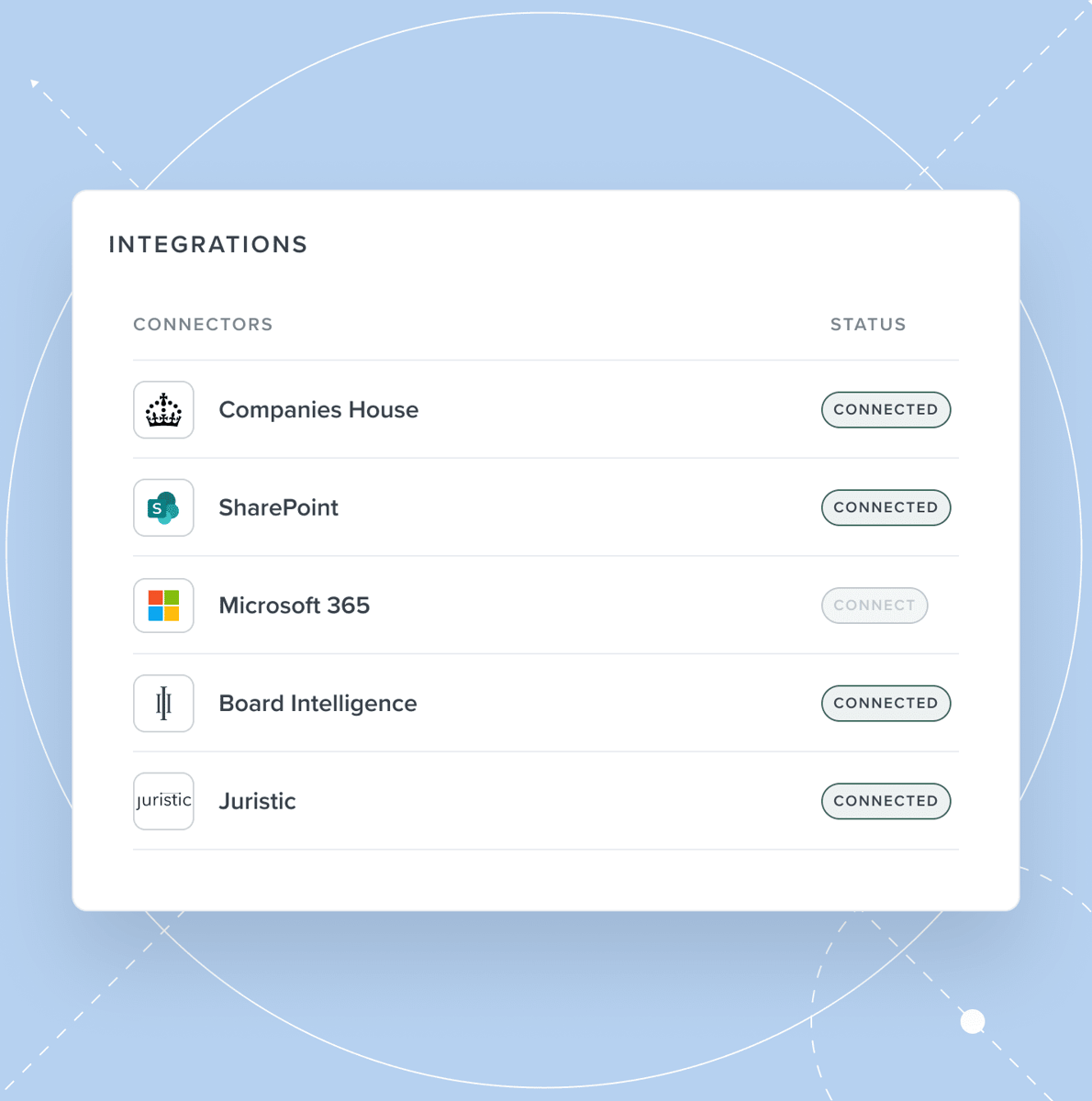
This is the problem IQ Entities, Board Intelligence's entity management system, is built to solve: holding entity records in one queryable place so a governance team can answer portfolio-wide questions from the organisation's own data, and automating routine compliance admin, where nothing happens until a person approves it. It doesn't remove the migration work described above, and no system makes a local registry stop being the legal source of truth. What it changes is how long it takes to get from a question to an evidenced answer. It sits alongside the board portal, so what governance teams verify about the group feeds the papers directors read.
Directors rely on their governance teams to keep subsidiary records straight. Their own job is narrower: knowing whether the answers they depend on can be produced and proved when someone outside the organisation asks. That's a question worth putting on an agenda before a bank, regulator, or auditor puts it there first.
FAQs
-
What is entity data fragmentation?
Entity data fragmentation is when a group's records of ownership, directorships, and jurisdictional detail are spread across multiple spreadsheets, shared drives, and systems, with no single authoritative version. The individual records are often accurate. What's missing is one place where anyone can confirm the current position and show where it came from.
-
Why is fragmented entity data a governance risk?
Fragmented entity data is a governance risk because directors are accountable for compliance across the whole group while relying on others to surface entity-level detail. When records need reconciling before anyone trusts them, the board approves positions nobody can evidence at the speed a bank, regulator, or auditor requires.
-
Who is responsible for entity data governance on a board?
Directors hold accountability for governance across the group, including its subsidiaries, and the governance team or company secretary holds day-to-day responsibility for maintaining and surfacing entity records. Those roles are distinct: a board cannot delegate its accountability, and a governance team cannot exercise the board's oversight on its behalf.
-
How can boards improve entity data governance?
Boards can improve entity data governance by asking how quickly a specific entity question can be answered and evidenced. That question tends to expose which records need reconciling, and it gives the governance team a mandate to consolidate entity data into one structured, auditable source.
-
What does ECCTA mean for entity data?
The Economic Crime and Corporate Transparency Act 2023 introduced identity verification requirements for directors and people with significant control, and tightened what UK groups must confirm and evidence about their registered information. For groups with many subsidiaries, that makes register accuracy an ongoing cross-entity exercise.