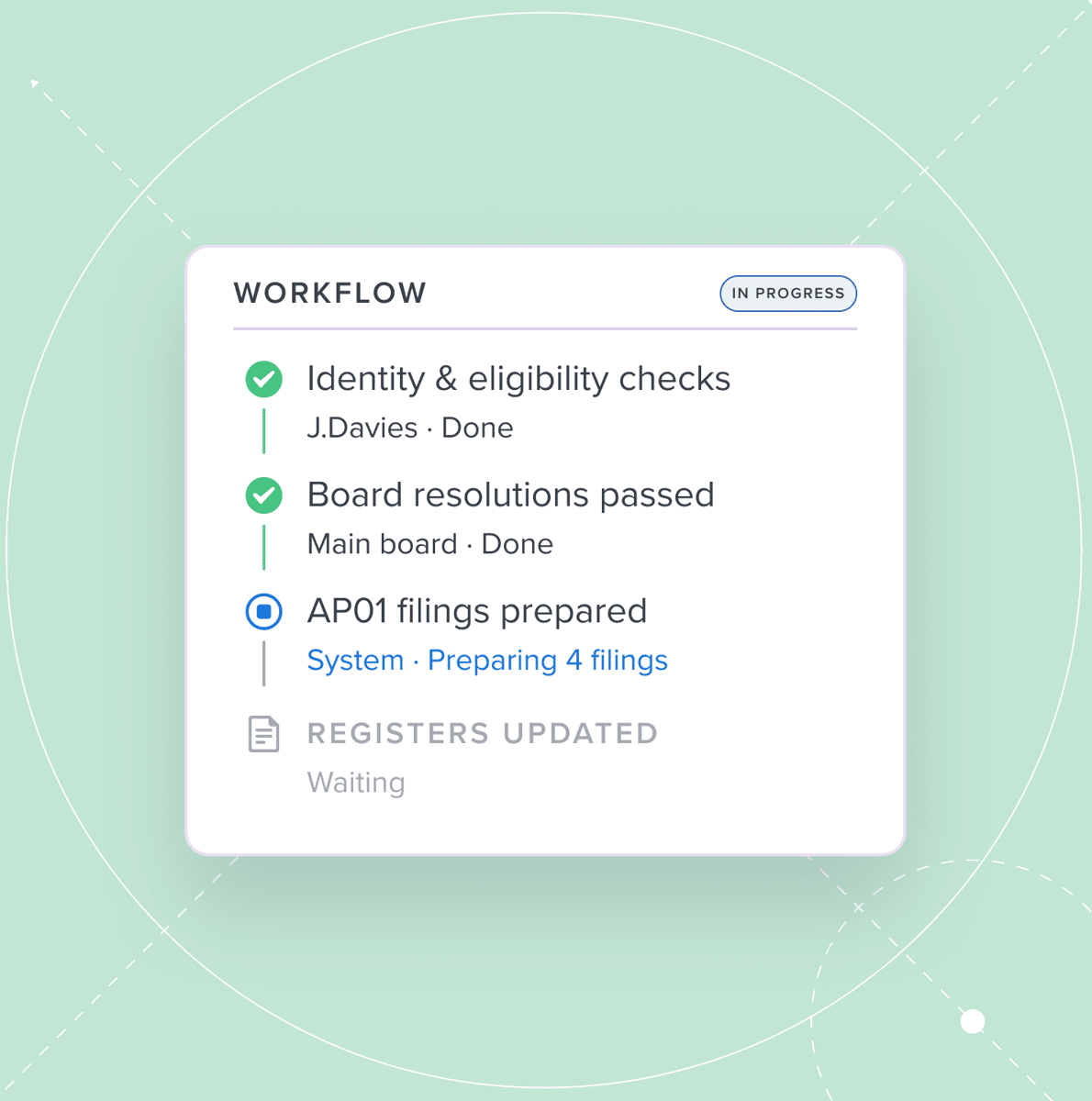
Yes, in large part. The word covers two very different things, and the difference is the whole answer. You can automate the flow of data between your internal records and Companies House, and you can automate the tracking of what falls due and when. The review and sign-off of a filing stays with a person, and no company secretary should want it any other way.
When a vendor says filings are automated, ask which part they mean. If they mean checking records against the register and prompting the right person at the right time, that is real and it works. If they mean filings going to the registrar with nobody checking them, treat the claim with suspicion.
The question has also changed shape. Under the Economic Crime and Corporate Transparency Act 2023 (ECCTA), the legislation reforming Companies House and the register, identity verification now attaches to people. The registrar can query and reject filings it once accepted. Companies House has confirmed that software will become the only route for filing accounts. Company secretaries have moved past the question of whether to automate. The live question is how to automate the parts that can be automated without losing control of the parts that cannot.
What does manual Companies House filing look like today?
Manual filing is three separate jobs done by hand: someone notices a filing is due, someone assembles the details, and someone submits it. Each step depends on a person remembering to act, which is where most filing problems start.
Someone has to notice a filing is due
Usually a company secretary, working from a spreadsheet, a calendar reminder, or memory. That holds while the reminder is accurate and the person who set it is still in post. It fails when someone leaves, when a newly acquired entity never makes it onto the tracker, or when a date is typed in wrongly and nobody checks it against the register.
Someone reconciles the details by hand
Officer details sit in one place, shareholdings in another, registered office details in a third, and the version on the public register may differ from all of them. Before filing, a company secretary works through those sources and decides which one is right. That reconciliation absorbs hours, and it is where errors enter the filing.
Company secretaries hold more dates than anyone can track
One entity gives a company secretary a handful of dates to hold. A portfolio of fifty gives them a document nobody has time to maintain properly. Companies House levied 297,682 late filing penalties in 2024/25, worth £157.2 million, so missed deadlines are common even among companies with one set of accounts to worry about.
What does "automated" mean in practice?
Filing automation means two specific capabilities: filing directly to Companies House under your own account, with read-only checks against the register, and proactive tracking of filing obligations. Neither of them submits a filing without a person approving it first.
Direct filing and read-only checks against the register
IQ Entities files directly with Companies House under your own presenter account, which you connect during onboarding. Board Intelligence is never the filer of record. Alongside that, IQ Entities checks your internal records against the public register and flags where they disagree, so a company secretary can see and fix a mismatch before it causes a problem.
The mechanism is what matters. Because the system checks records against the register continuously, a company secretary stops reconciling sources by hand before preparing a filing, and stops discovering a discrepancy at the point of submission. The check shows where your records and the register disagree. It makes no judgement about whether a filing is correct, and it submits nothing without your approval.
Automatic tracking of what's due and when
Automatic tracking replaces the spreadsheet. The system holds each entity's obligations and dates and prompts the responsible person ahead of each one. Company secretaries stop maintaining a parallel record of deadlines and work instead from a single view across every entity. IQ Entities, Board Intelligence's entity management system, includes direct Companies House filing, read-only register checks, and this kind of tracking, alongside Intelligent Insight, which answers questions about entities across a portfolio.
What does automation not replace?
Automation does not replace human review and sign-off before a filing is submitted. Since ECCTA, that boundary has become sharper and easier to describe, because three of the things a filing now depends on sit outside any system's reach.
Software cannot verify that a person is who they say they are.
Identity verification under ECCTA attaches to an individual. Directors and people with significant control have to verify themselves, and a verified person carries a personal code that must be connected to each company they serve. A company secretary can hold officer data in perfect alignment with the register and the filing can still fail, because identity verification depends on a person. Data quality and identity are separate problems, and only one of them is a software problem.
Software cannot judge whether a change was properly authorised.
It cannot confirm that a resolution was passed correctly, that a board made the appointment, or that the person named as a director is the person the board appointed. Those are judgements, and the filing obligation sits with the company and its officers. .
Software cannot answer for the filing if the registrar queries it.
The registrar now has powers to query, reject, and remove material from the register, which means a submitted filing is not a finished filing. A rejection creates work: someone has to read the objection, find what went wrong, correct it, and resubmit, often against a deadline that has not moved. If a vendor's answer to "what happens on rejection" is that the system resubmits, treat that as a warning sign. Automatic resubmission sends the same defect back to the registrar.
This is why the automation worth buying handles the preparation and leaves the submission decision with a person. Where a system does act on its own, as IQ Entities does through Agentic Action for administrative compliance tasks, it should do so with human review built into the workflow, and you should be able to see exactly where that review happens.
Why does this matter more as entity count grows?
The gap widens because the work automation removes scales with the portfolio, while the work it leaves behind does not. Review and sign-off take a company secretary broadly the same time per filing whether the group holds five entities or five hundred. Chasing details across records, maintaining the deadline tracker, reconciling internal data against the register, and now checking that every officer of every entity holds a verified identity all multiply. Companies House issued 75,062 double penalties in 2024/25 against companies that filed late in two successive years, which is what a tracking problem looks like once it sets in.
Identity verification makes the arithmetic worse in a way that catches groups out. A director who sits on several boards verifies once, and the personal code has to be linked to each company. A director's practical deadline is driven by the earliest filing date across all of them. In a group with dozens of entities and overlapping directorships, keeping track of who has verified and which entities have the code recorded is a portfolio-level job. Nobody does it well from memory.
For fund, trust, and corporate service providers running filings across hundreds of entities, that is an operational risk, which is why this group tends to centralise entity records and board materials on a single platform. Our work with Apex Group shows what that looks like at scale, across 540 clients in more than 20 countries. The same logic that makes a board portal worth having for meeting materials applies to entity data: one current record, visible to the people accountable for it. Fragmented entity data creates governance risk well beyond any single filing.
What is changing at Companies House in 2028?
Companies House will require all accounts filings made on or after 1 April 2028 to go through commercial software in iXBRL format. The web and paper routes close for accounts from that date and stay open for other statutory filings. The original date was April 2027, and Companies House confirmed the revised timetable in June 2026.
Filing automation will not make the compliance question easier before or after that date. The register is getting stricter, and a company secretary who has a governed filing process in place before the deadline has one less thing to build under time pressure.
What should you ask a vendor before you buy?
- Which step is automated? Preparation, submission, or both, and what evidence can you show?
- Where does the approval gate sit? Does a named person approve before submission, or is review after the fact?
- What happens when the registrar rejects or queries a filing? Who is notified, and does the system resubmit automatically?
- Who is the Authorised Corporate Service Provider? An ACSP is a firm registered with Companies House to file on behalf of others and verify identities. If filings go via your software or your people, ask who holds that registration and whether it is current.
- What does the audit trail record? Which person approved what, when, and against which version of the data.
A vendor who answers those five clearly is describing a system you can govern. To see how IQ Entities handles direct Companies House filing, register checks, tracking, and audit trail across a portfolio, look at our entity management module.
Book a demo and see it in action.
Book a demoFAQs
-
Does identity verification change what filing software can do for me?
Yes. Identity verification under ECCTA applies to individuals, so directors and people with significant control have to verify themselves and cannot delegate that to a system. Software can track who has verified and which entities hold their code, which is useful, and it cannot complete the verification on anyone's behalf.
-
Can software file with Companies House on my behalf?
IQ Entities files directly with Companies House, always under your own presenter account, which you connect during onboarding. Board Intelligence is never the filer of record, and a person still approves every filing before it goes.
-
What is an Authorised Corporate Service Provider, and why does it matter here?
An Authorised Corporate Service Provider (ACSP) is a firm registered with Companies House to carry out certain functions, including filing on behalf of others and verifying identities. If your filings go through an agent or through a vendor's service rather than your own people, the ACSP question belongs in procurement, because an unregistered route can leave you unable to file.
-
What happens if a Companies House filing is rejected?
The filing is treated as not delivered, so the deadline continues to run while someone corrects the problem. Whoever is accountable needs to see the rejection quickly, understand the cause, and correct it before resubmitting, which is why notification and audit trail matter more in a rejection than in a clean submission.
-
What happens if a Companies House filing is missed?
Companies House can issue late filing penalties, and persistent failure can lead to enforcement against the company and its officers, including strike-off. Penalties doubled for a second consecutive late year, and Companies House issued 75,062 of those double penalties in 2024/25. Current deadlines and penalty amounts are set by Companies House and change from time to time, so check live guidance.
-
When does Companies House software-only filing start?
All accounts filings made on or after 1 April 2028 must go through commercial software in iXBRL format. Companies House will close its web and paper routes for accounts on that date, and both remain available for other statutory filings such as confirmation statements.