Entity management platforms all read the same on a feature list. Board Intelligence built this checklist so you can compare them on the things that change your working week. It sets out six criteria to put to any platform, and the questions to ask in a vendor call, so you walk away from a demo with answers.
How many entities and jurisdictions does the platform support?
Ask a vendor for a number, then ask how the platform behaves in a jurisdiction it has not seen before. A vendor might claim unlimited entities. If your team then has to set up every rule for every country by hand, you carry the work whatever number the vendor puts on the label.
Board Intelligence built IQ Entities for governance teams running entities across several jurisdictions. Its AI reads your paperwork, prepares record updates and filings, and answers questions about any entity in the group. IQ Entities redraws the group structure chart as records change, and exports it to PowerPoint and Word as editable shapes.
A company secretary using IQ Entities sees the right fields for each jurisdiction. Setting up a German entity, they are offered GmbH, AG and UG. Setting one up in Delaware, they are offered Corporation and LLC. You configure a jurisdiction once, and IQ Entities then applies that jurisdiction's rules as dated tasks against every entity in it.
Ask any vendor what happens the first time you add a jurisdiction they have not configured before. Then ask them to run the platform against a group the size of your own, with the structure chart drawn from live data.
Does it handle multi-jurisdiction filing, or just UK filing?
Vendors blur this line, so be precise. A platform can track filing deadlines across 40 countries and still submit to the registry in one of them. Ask which jurisdictions it files to directly, and where it only keeps records and raises reminders.
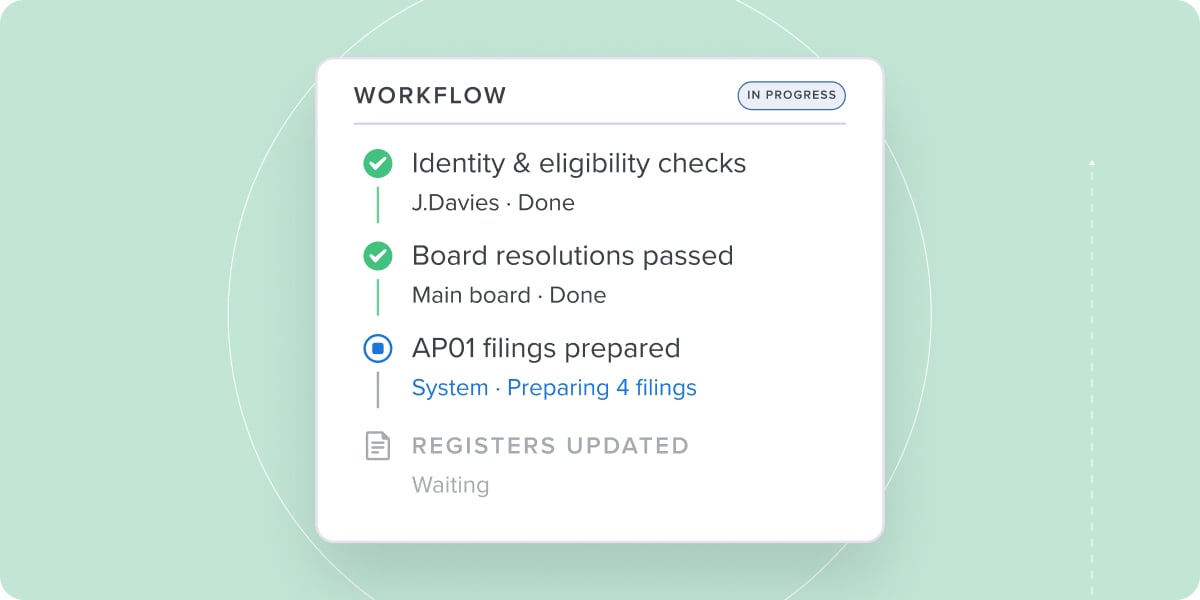
IQ Entities files directly with Companies House in the UK, under your own presenter account, which you connect during onboarding. It also checks your records against the public register, so you can fix any differences before someone else finds them. In other jurisdictions, you get jurisdiction-aware records and mapped obligations, including beneficial-ownership reporting such as the UK PSC register. Board Intelligence is adding further registry integrations. You map an obligation once, for example a new director appointment triggering an AP01 within 14 days, and IQ Entities then raises the task, assigns an owner and starts the clock.
You have a date to plan against. From April 2028, Companies House will require all UK-registered companies to file their annual accounts in iXBRL format using commercial software, and its web and paper routes will close for accounts filings. Web filing stays open for confirmation statements and updates to director details. If you are weighing up platforms now, work back from that deadline.
How does it handle permissions across subsidiaries?
Finance, the CEO, directors, auditors and external advisers each need a different slice of the portfolio. Ask for role-based, read-only access.
IQ Entities holds one structured register for ownership, directors, officers and roles, with granular permissions on top of it. You can tie permissions to a position, so a colleague appointed to a new role picks up access to the entities that role covers and loses it when they move on. Give a finance or tax colleague read-only access and they can ask the in-app assistant about an entity directly, including who the ultimate beneficial owners are.
Without that, your company secretary pulls extracts by hand and redacts them every time a colleague outside the core team needs a partial view. Two people then work from two differently cut extracts, and neither of them knows which one is current.
Ask to see the permissioning live in the demo, with an account blocked from an entity it is not cleared for.
What does migrating from your current system involve?
Your existing entity records sit in spreadsheets, in PDFs of statutory filings, and in your company secretary's own knowledge of who owns what. Read across those sources and you will find they contradict each other. One person recorded a director resigning in March. Another filed a PDF giving April. Someone has to read both and decide which one is correct before that record goes near a new system.
IQ Entities takes the retyping out of that. You bulk-upload your existing documents, the AI reads them and proposes each change with a citation to the page it came from, and a named person accepts or rejects each one before it becomes the live record. Your team keeps the judgement calls. Someone still has to decide which of two conflicting sources is right, so ask vendors to quote that decision-making time separately.
Ask any vendor for two timelines, one for data ingestion and one for reconciliation. If a vendor gives you one number, ask which of the two it measures.
What security and compliance standards should you require?
Set the standard before you hear any vendor's answer to it. At minimum, ask for independent audit of information security controls, encryption of data in transit and at rest, and penetration testing carried out by a third party.
IQ Entities is ISO 27001-audited, encrypts data in transit and at rest, and is independently penetration-tested. Board Intelligence applies zero data retention and never uses customer data to train AI models.
Ask a vendor to name its certifications and show you the audit scope. "We hold ISO 27001 and can show you the audit scope" gives you something checkable. A description of a security "posture" gives you nothing to verify.
Ask what happens to entity data fed into an AI feature. If a vendor cannot answer that without going away to check, treat it as unanswered.
IQ Entities is ISO 27001-audited, encrypts data in transit and at rest, and applies zero data retention. See how it handles security and permissions.
Book a demo and see it against your own entities.
Book a demoDoes a person approve every AI-suggested change?
AI that proposes record updates saves your team the retyping. Someone still has to catch an error before it reaches the statutory register.
Ask a vendor whether a named person has to accept each AI-suggested change, and ask to see that approval step in the demo. Ask what the audit trail records, and whether you can trace a change back to the document it came from and the person who approved it.
With IQ Entities, the AI cites the page each proposed update came from, and a named person accepts or rejects it. Nothing is filed until a person approves it.
Six questions to put to every vendor
Use these six questions in any vendor call. Write down the exact answer, and note where a vendor gives a general impression in place of one.
- How many entities and jurisdictions do you support, and what happens when we add one you have not set up before? A buyer learns little from the number alone. Listen for how the platform behaves the first time it meets a new jurisdiction’s rules.
- Which jurisdictions do you file to directly, and where do you only keep records and raise reminders? Get the answer in writing. Vendors use "multi-jurisdiction support" and "multi-jurisdiction filing" to mean different things.
- Can you show us role-based permissions live in this demo? Ask to watch an account get blocked from an entity it is not cleared for. A vendor who only shows a slide has proved nothing.
- Who owns reconciliation during migration, and how long does that take separately from data ingestion? If a vendor gives one combined timeline, ask them to split it.
- Which certifications do you hold, and what happens to our data if we use your AI features? Ask for the certification names and the audit scope.
- Does a named person have to approve every AI-suggested change before it becomes the live record? If the answer is no, ask who catches an error before it reaches your register.
Buy for the moment someone asks for evidence
A vendor who has built for multi-entity, multi-jurisdiction governance answers all six of these quickly. Watch for the question where a vendor reaches for reassurance, because that is where a buyer learns the most.
A bank, an auditor or a regulator will eventually ask a governance team to evidence who owns what, who approved a change, and when. A team choosing a platform today decides whether it produces a two-minute export in that moment or spends a week reconstructing the record.
See how Board Intelligence's IQ Entities measures up against this checklist. Book a demo.
FAQs
-
What should I look for in entity management software for a large, multi-entity enterprise?Look for jurisdiction-aware records, role-based permissions, a realistic migration plan, and named security certifications, and ask a vendor to state which jurisdictions it files to directly. A platform that treats every entity the same way regardless of jurisdiction leaves someone on the governance team doing that translation work by hand.
-
Can entity management software file in multiple jurisdictions automatically?Check this vendor by vendor. IQ Entities, for example, files directly with Companies House in the UK today, under the customer’s own presenter account. In other jurisdictions it gives governance teams jurisdiction-aware records and mapped obligations, and a person submits the completed filing to the registry. Ask any vendor you are evaluating to set out that split.
-
How does permissions handling work across subsidiaries?
A platform should give role-based, read-only access so finance, the CEO, directors and external advisers each see only the entities they are cleared for. Some vendors let a team tie permissions to a position, so a colleague keeps the right access as their role changes. Ask any vendor to demonstrate this live, showing an account blocked from an entity outside its permissions.
-
How long does migration from an existing system take?
Ask for two separate figures, one for data ingestion and one for reconciliation. Teams usually spend longer on reconciliation, where someone decides which of two conflicting records is correct, and how long depends on how consistent the current records already are.
-
What security certifications should entity management software hold?At minimum, ask for independent audit of information security controls, encryption in transit and at rest, and third-party penetration testing. Also ask what happens to your data if you use the platform's AI features, since not every vendor can answer that cleanly.