A bank asks for a current group structure chart. Three different versions turn up, and none of them agree. One came from last year's audit pack, one from an adviser working the last acquisition, one from a colleague who left in March.
Company secretaries keep records precisely so this doesn't happen. It's a statutory duty, not paperwork for its own sake. Directors can't discharge their duties over a group they can't accurately describe, and the officers who maintain the records carry personal exposure when they get it wrong.
What is entity management, in plain terms?
Entity management is the work of maintaining the statutory record for every company, subsidiary, partnership, and branch in a group, and being able to evidence that record on demand. It covers who owns each entity and in what proportion, who its directors and officers are, where it is registered, which filings it owes and when, and how the entities relate to each other in the group structure.
The Companies Act 2006 requires a UK company to keep a register of members, and that register is the primary evidence of legal title to its shares. Under the Act, companies must also maintain information on people with significant control. The Economic Crime and Corporate Transparency Act 2023 has moved some of this record-keeping toward Companies House centrally, while the register of members stays the company's own to keep. Failure to maintain the required registers is an offence committed by the company and by every officer in default.
Groups do not get to decide whether entity records matter; the only decision left to them is whether they run those records through a spreadsheet or a system.
What does entity management software do?
Entity management software turns scattered entity records into a single, structured system of record, and keeps that record current and evidenced. Most groups already have this information. They just have it in fragments: ownership sits in one spreadsheet, director records in another, filing deadlines in someone's calendar or inbox, share certificates in a shared drive nobody has tidied since the last acquisition.
At one or two entities, a company secretary can hold the whole picture in their head and reconcile any gaps by hand. That breaks down as a group grows through acquisition, international expansion, or simply time, because records move between people and systems without a clean handover. Each move leaves behind a version that disagrees with the others, until nobody can say which one governs.
The consequences are specific. A missed confirmation statement or a late set of accounts brings a penalty, and persistent failure can put an entity on the path to strike-off. A share transfer recorded in one place and not the register of members leaves ownership open to challenge, often at the exact moment it matters most: in a sale or a refinancing. A bank that can't reconcile a company's directors and signatories against its own file won't move money. Due diligence stalls while a team reconstructs the last decade of appointments from board minutes. Nobody sees these failures coming, which is what makes them expensive.
Where should ownership and structure data live?
Company secretaries should hold ownership in one structured, dated record that everything else reads from. Shareholdings, share classes, transfer dates, and parent-subsidiary relationships are connected fields, so a change entered once updates the group picture everywhere it appears. Keep that information in a spreadsheet, a slide, and a PDF chart instead, and the three drift apart, with no way of telling which one came last.
Structure sits behind more obligations than most people expect. A register of members is the primary evidence of who owns a company's shares. PSC information feeds the public register, and through it, every counterparty running an ownership check. Where an overseas entity in a group holds UK property, the Register of Overseas Entities requires its beneficial owners to be registered, and without that registration the group cannot register a disposition of the property at HM Land Registry, which can halt a sale outright. Sanctions teams face a harder version of the same question, since they must trace ownership and control through the chain rather than read it off the top layer. Each of these obligations comes back to one thing: knowing, today, who owns what.
Jurisdiction is where this gets difficult. A group with entities in Luxembourg, Delaware, and Singapore faces different filing regimes, different registers, and different definitions of the same office.
IQ Entities, Board Intelligence's entity management system, files UK company filings directly with Companies House. Those filings go under the company's own presenter account, which a customer connects when they set the system up, so the company stays the filer on record. IQ Entities also checks its records against the public register and flags where a company's systems, its documents, and Companies House disagree.
Companies House covers the UK only. Company secretaries running entities in other jurisdictions should ask any vendor which registers they file to, which they check against, and which they only store data for.
Book a demo and see it in action.
Book a demoHow do you keep track of directors, officers, and roles across entities?
Company secretaries should hold appointments as dated records against both the person and the entity, so they can see one director's full set of roles across the group from a single place. A resignation is rarely a single event: it can trigger filings in several jurisdictions, leave a subsidiary short of a quorum, and invalidate bank mandates on the same afternoon.
Identity verification has raised the stakes. Since 18 November 2025, the Economic Crime and Corporate Transparency Act has required UK directors and PSCs to verify their identity with Companies House, and their personal codes now flow through appointments and confirmation statements. A company secretary supporting a director who sits on fifteen boards across the group needs to know all fifteen, along with which confirmation statement falls next. Rebuilding that list by hand each time someone asks is how deadlines get missed.
How do you stay on top of compliance deadlines and filings?
Attach every statutory obligation to an entity record and a named owner, with a date. The mechanism is ownership plus visibility: a deadline held in one person's memory leaves the organisation when they do, while a deadline held against a record does not.
Some entity management software prepares and submits statutory filings, which puts a vendor's product in the path of a legal document. Company secretaries evaluating those products should establish two things in the first demo. First, whether someone approves each submission before it goes, or only sees it after. Second, whose name Companies House records as the presenter. That name should be the company's own, so the company stays the filer on record rather than relying on a vendor's credentials. Any vendor should be able to show the approval step and the audit trail behind both.
Who uses entity management software?
Company secretaries and governance teams use entity management software most. Corporate service providers use it to administer entities for their clients, and legal, tax, and finance teams rely on the data it holds.
A company secretary carries personal responsibility for the accuracy of the statutory record and cannot verify it from memory across dozens of entities. They also field the questions that come in from banks, auditors, and the board, usually at short notice, usually without a week to reconcile the record first.
Before buying, understand what is involved in migrating and reconciling your existing data. A company secretary and their team may need to reconcile registers against Companies House, find missing share certificates, and resolve contradictory versions of the same shareholding. Some of that work may still be manual. Ask vendors what their migration process involves, what they need from your team, and for a realistic timeline based on organisations of a similar size and complexity.
Corporate service providers face the same problem at greater volume. They administer entities for many separate clients, keep each client's records segregated and auditable, and lose business when a filing slips, because the client sees a missed deadline as a service failure. A provider running several hundred entities across jurisdictions cannot build a reliable portfolio view by hand.
Legal, tax, and finance teams rarely maintain the record themselves, though they inherit the consequences when it is wrong. They draw on it for transaction due diligence, transfer pricing, statutory accounts, consolidation, and dissolutions. Tax teams need ownership percentages and incorporation dates that hold up under challenge, because the structure a group holds determines the tax treatment it gets.
What's the difference between entity management and board management software?
Entity management software holds the statutory record of what a group owns and who is accountable for each part of it. Board management software, usually called a board portal, holds the documents a board needs to meet and decide, along with the permissions and distribution around them.
Company secretaries get caught where the two meet. Subsidiary minute books, written resolutions, and delegated authority matrices sit in both systems at once. A written resolution approving a share allotment is a board document, and it is also the source for a register entry and a Companies House filing. A board portal handles version control, access permissions, secure collaboration, offline access, and e-signatures for board papers. It leaves ownership records and filings to the entity management system.
The practical test is whether a decision recorded in one system reaches the other. Groups that keep them connected close the gap between what the board approved and what the register says. Groups that do not usually discover the gap during diligence.
Why does entity management matter now?
Companies House reform has made this a live agenda item rather than a background task. Under the Economic Crime and Corporate Transparency Act 2023, identity verification for directors and PSCs came into force on 18 November 2025, with existing officeholders working through the transition via their next confirmation statement. Further phases, covering those who present filings and the designation of a relevant officer where a legal entity is a PSC, are expected later. Alongside this, the registrar holds new powers to query information, reject filings, change an inappropriate registered office, and strike off companies formed on a false basis. A register that once absorbed inaccuracy now pushes back on it.
Group complexity has moved the other way. Acquisitions bring entities with inherited record-keeping habits and no clean handover. International expansion adds jurisdictions with different filing regimes. Dormant entities linger long after anyone remembers why they exist, each one carrying filing obligations, director appointments, and audit questions. That is why group simplification programmes keep reaching board agendas, and why they stall: you cannot rationalise a structure you cannot describe, and the first task in any simplification is establishing what you own and what each entity holds.
None of this makes entity management enjoyable work. It stays detailed, unglamorous, and dependent on people chasing colleagues for documents. What a system of record changes is where the effort goes: into resolving the record once, rather than reassembling it every time someone asks. For the company secretary who can produce the structure, the appointments, and the filing position on demand, that is the difference between defending the record and rebuilding it under time pressure.
FAQs
-
What is entity management software?
Entity management software is a system of record for a group's legal entities, holding ownership, directors and officers, registered details, filings, and deadlines in one structured place. It replaces the spreadsheets, shared drives, and calendar reminders most organisations rely on by default, and it lets a governance team evidence the position for any entity without reconstructing it first.
-
Is entity management the same as company secretarial software?
The terms overlap almost completely in practice, though entity management is the broader one. Company secretarial software usually describes the tools supporting a company secretary's statutory duties, while entity management covers the underlying entity data that legal, tax, finance, and compliance colleagues also depend on.
-
Do small companies need entity management software?
A single company with one director maintaining its own records rarely needs dedicated software, because the statutory registers are short enough to keep accurately by hand. The calculation changes once entities multiply or responsibility passes between people, since that is when versions diverge and nobody can identify which record governs.
-
What's the difference between entity management and board management software?
Entity management software maintains the statutory record of the entities a group owns. Board management software, or a board portal, centralises the papers, permissions, and distribution for board meetings. The two meet at subsidiary minute books and written resolutions, which are board documents and part of the statutory record at the same time.
-
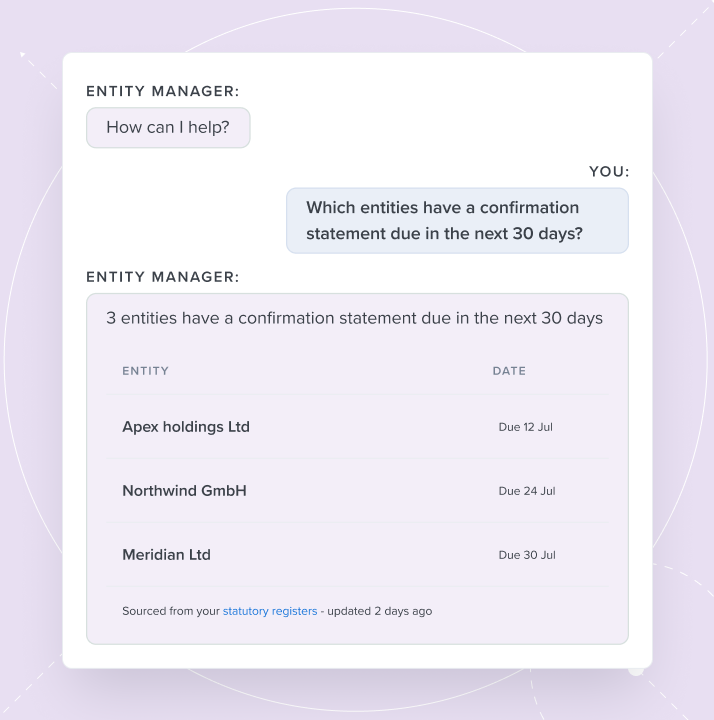
How does AI help with entity management?
AI helps with entity management in two ways: it can answer questions across a portfolio of entity records, and it can prepare routine compliance tasks for a person to approve. Both depend on the underlying data. A well-built system flags contradictions, like three different versions of the same shareholding, rather than guessing between them. Ask any vendor how their system handles contradictions, and make sure there’s a clear human approval step before anything is filed.