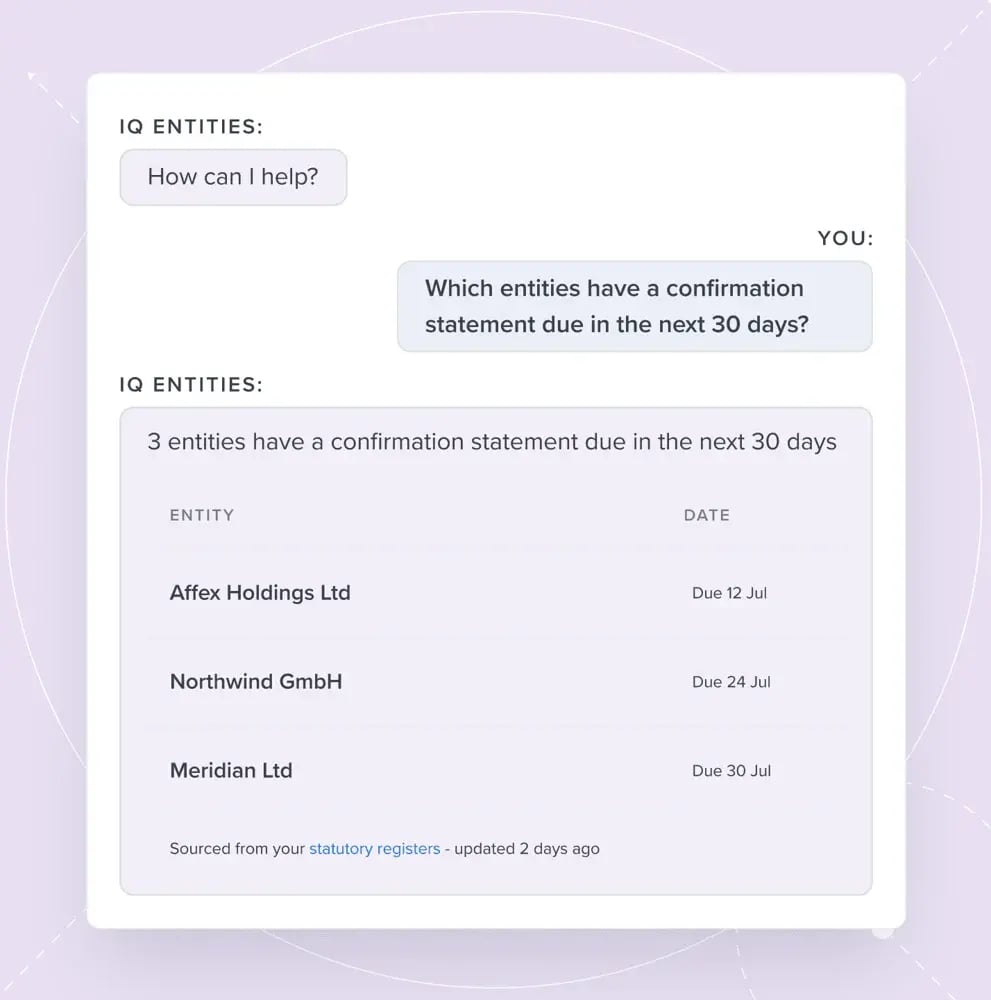
Entity management software is a single system of record for an organisation's legal entities. It holds registration details, directors and officers, shareholdings, and statutory deadlines for every entity in the group. An entity management system also turns each entity's obligations into dated tasks, and in the UK it can prepare Companies House filings for the company secretary to approve.
Below, we follow a single director appointment from the board's resolution to the filing at Companies House, and finish with six signs that a governance team's spreadsheets have reached their limit.
What is entity management software?
Every group gets a version of the same request. A bank opening an account for a subsidiary wants to know who owns it and who can sign on its behalf. If the company secretary keeps one record per entity, that's a minute's work. Where the answer is spread across 40 spreadsheets, a shared drive, and the inbox of someone who left last year, the company secretary can spend a fortnight putting it together and send it out already out of date.
A company secretary with entity management software gives the one-minute answer every time. The software holds the statutory record for every legal entity in the group, in four parts:
- Entity and registration details: legal name, company number, jurisdiction, registered office, and status.
- Directors and officers: who holds each appointment, from which date, and who has resigned.
- Ownership and share capital: share classes, holdings, and the parent and subsidiary links that make up the group structure.
- Compliance obligations: each filing and statutory requirement the entity owes, with its deadline.
Teams keep the first three in a spreadsheet easily enough. The fourth needs a system that watches dates, so the company secretary hears about a confirmation statement a fortnight out, and about the 14-day window to notify Companies House of yesterday's director appointment. Companies House issued 297,682 late filing penalties in 2024 to 2025.
Other people depend on the same record. Finance wants a correct list of subsidiaries at year end. Tax needs ownership percentages it can defend if HMRC asks.
Individuals carry the risk personally. Directors owe their duties personally under the Companies Act 2006, and the company secretary, as an officer of the company, can face penalties when a filing is missed. The board relies on the same record whenever it approves a restructure. Penny Hughes CBE, Chair of The Gym Group, put it plainly: “You can’t have an effective board without an effective Company Secretary.”
There is a second deadline worth planning around. Under the ECCTA reforms, Companies House will only accept accounts filed through software from April 2028. UK groups still filing by hand need a system in place well before that.
Book a demo and see it against your own entities.
Book a demoWhat counts as an entity, and where records drift
An entity, for these purposes, is anything the group has to keep statutory records and make filings for: companies, limited liability partnerships (LLPs), partnerships, trusts, and branches.
People use trading companies every day, so those records stay in good order. Company secretaries find the problems elsewhere:
- Dormant companies kept to protect a name. They don't trade, but they still owe a confirmation statement and accounts every year.
- Joint ventures, where ownership is shared and the other party keeps its own records.
- Entities set up to operate in a single country, often run day to day by a local team.
- Captive insurers and holding companies left over from past deals.
Company secretaries trace most of the drift to ordinary events. The most common is a handover that never happens. The person who kept the registers moves roles or leaves, their spreadsheets stay on the shared drive, and nobody picks up the job of updating them. A year later, the next person to open the file cannot tell which rows are still accurate.
Directors add to it without meaning to. A director who moves house has to be recorded at the new address in the company's register and at Companies House, and has little reason to think of telling the company secretary. The old address sits on file until a letter comes back or someone happens to ask.
A regional team that runs its own entities files locally and keeps its own records, and the faster the group expands, the further those records drift from the ones held centrally. Someone at the centre has to require the region to report every change, or the two records keep diverging.
Nobody notices any of this day to day. Someone finds it when they need a particular entity in a hurry. A subsidiary left unused for a couple of years can lose its good standing because nobody was tracking what it owed, and the team discovers the problem when a transaction depends on it.
How entity management software works, step by step
The easiest way to see how the software works is to follow one change through it. Take a UK subsidiary whose board has just appointed a new director.
- The board approves the appointment by resolution, and the company secretary adds the new director to the entity's record with the date of appointment. Some systems will read the signed resolution and propose the change for the company secretary to check. Because there's one record per entity, the appointment appears in the register of directors, in the director's list of roles across the group, and in any report drawn from either.
- The system's obligations engine, which holds the rules for each type of entity in each jurisdiction, picks up that a UK company has 14 days to notify Companies House of a new director. It sets that deadline against this entity.
- A named owner picks up that deadline as a task on the team’s compliance calendar. If the appointment triggers other work, such as collecting the director's details, checking their identity verification, or updating bank mandates, a workflow can raise those tasks at the same time.
- When the company secretary opens the task, the Companies House form is already filled in from the record, including the director's Companies House personal code. The company secretary checks the form and approves it, and the system submits it under the company's own presenter account (the credentials a company uses to file at Companies House).
- When Companies House accepts the filing, the task closes and the history stays against the entity. Some systems also compare their records with the public register each day and flag differences, which catches anything a lawyer or agent filed directly.
- Anyone who needs to see the result, whether a director, an auditor, a bank, or a colleague in finance, can be given read-only access to the relevant entities. They can check the appointment without emailing the company secretary.
A share transfer runs through the same sequence, with one addition at the end. The system redraws the group structure chart from the updated register of members, so nobody rebuilds it in PowerPoint.
How far the system can go depends on the registry at the other end. Companies House accepts filings from software, so a team can submit UK filings directly. Many registries elsewhere have no electronic filing route at all. For entities in those jurisdictions, the system keeps records to local requirements and tracks each obligation, then prepares the completed document for someone to submit locally.
IQ Entities, Board Intelligence's entity management system, follows this sequence. It submits UK filings directly to Companies House under the company's own presenter account. For entities in other jurisdictions, it tracks each obligation and prepares the completed documents for local submission. Nothing is filed until a person approves it
Entity management software and board management software are not the same thing
Entity management software holds the facts about each company, covering who owns it, who runs it, and what it owes. A board portal holds the board's papers, minutes, and approvals. It controls who can see each document and keeps track of versions. It doesn't hold the register of members or submit filings.
People confuse the two because the same person usually runs both. In most groups the company secretary looks after the portal and the entity records, and the same governance team supports the board and its committees.
The two meet wherever a board decision changes the record. The resolution appointing a director sits in the portal as a board document, and the company secretary also uses it as the source for the register entry and the Companies House filing. Where a group connects the two systems, the company secretary enters each change once.
Six signs a governance team has outgrown spreadsheets
- Nobody owns each entity's record. Several people update the same spreadsheet, none of them owns it, and the team has no way of knowing which rows are current.
- The team rebuilds the group structure chart by hand. The register of members and the chart have stopped agreeing with each other.
- The filing calendar lives in one person's head. Deadlines that sit in a personal Outlook calendar leave with the person who set them.
- The same change gets entered in four places.
- A routine request takes days. A bank, a lender, or an auditor asks who owns a subsidiary and who can sign for it. The company secretary reconstructs the answer from several sources before sending it. Then the next request arrives and the work starts again.
- The team finds out about changes after the fact. A local team or an external adviser files something directly, and the central record catches up weeks later, or not at all.
Three or more of these together, and the company secretary spends more time maintaining the record than using it.
Where to go next
Company secretaries tend to ask two questions next. What should a team look for when it buys a system, and where should automation stop and a person's judgement take over? We set out the questions to put to a vendor, including how long migration will realistically take, are in our plain-English guide to entity management. On where automation should stop, our piece on whether Companies House filings can be automated explains why a person's sign-off stays in the process.
IQ Entities is Board Intelligence's AI-native entity management system. Its AI reads resolutions, registers, and certificates, proposes the record updates, and cites the page each one came from. It redraws structure charts as records change. Colleagues in finance, tax, and audit can ask it about any entity and get a sourced answer without going through the company secretary. A person approves every change before anything is written to the record.
Teams let entity records go wrong slowly, over years. The problem usually comes to light when a bank or a regulator asks a question that ought to take half a minute. With a single, current record, the company secretary can answer the question while they're still on the call.
FAQs
-
What is an entity management system?It's software that keeps the statutory record for each legal entity in a group, covering registration details, directors and officers, ownership, and compliance obligations. It turns those obligations into dated tasks, and in the UK it can prepare and submit Companies House filings once a person approves them. The terms entity management system and entity management software are used interchangeably.
-
Who uses entity management software?Company secretaries and their governance teams use it every day, and corporate service providers use it to run entities for their clients. Colleagues in finance, tax, legal, and audit usually have read-only access, so they can check an ownership percentage or an appointment without going through the company secretary. Directors can be given the same access to the entities they sit on.
-
What is the difference between entity management software and board management software?Entity management software holds the facts about each company, covering its owners, officers, and filing obligations. Board management software, often called a board portal, holds the board's papers, minutes, and approvals. The two meet at decisions such as a director appointment, where the resolution sits in the portal and the register update and Companies House filing sit in the entity management system.
-
Can entity management software file with Companies House?Some systems can. They fill in the form from the entity's record and submit it through Companies House's software filing route, using the company's own presenter account, once a person has reviewed and approved it. Most registries outside the UK have no equivalent route, so for entities there the system prepares the document and someone submits it locally.
-
Do you need entity management software if you only have a handful of subsidiaries?Not necessarily. Five subsidiaries looked after by one careful company secretary can run well on spreadsheets. The case for software grows when several people share the record, when the group spans more than one jurisdiction, or when the filing calendar lives in one person's head. The six signs above are a reasonable test.
-
Whose job is entity data, the company secretary’s or the legal team’s?In most groups the company secretary owns the statutory record, as the officer who normally keeps the registers and makes the filings. The legal team tends to advise on structure, transactions, and new jurisdictions, and may make some filings directly. Private companies don't have to appoint a company secretary, and where they haven't, the duty falls to the directors. Whoever holds it, each entity's record needs one named owner.