Board communication is not the same as ordinary workplace communication. Directors share confidential papers, make consequential decisions, and operate under regulatory and legal obligations that email and standard collaboration tools were never designed to support.
Yet many organisations still rely on email to distribute board papers, shared drives to store materials, and generic messaging platforms to keep directors informed. These tools create governance risks: documents circulate in outdated versions, sensitive materials are hard to control, and there's no clear audit trail of who saw what, when. According to our Board Value Index, poor-quality information is one of the leading barriers to effective board decision-making. The tools boards use to communicate are a direct contributor.
This article explains what dedicated board management software should enable, which features to prioritise, and how the leading platforms compare. If you're evaluating options, you'll find a clear framework and a comparison table to help you decide.
Why board communication needs dedicated software
The limits of email and generic collaboration tools
Email is convenient. It’s also poorly suited to the demands of board governance.
When board papers are circulated by email, version control breaks down almost immediately. Directors work from whichever attachment arrived in their inbox, which may not be the most recent one. When amendments are made, there’s no reliable mechanism to ensure every recipient is reading the same document. Annotations and comments live in separate threads or offline, never consolidated into a shared view.
Generic cloud collaboration platforms like SharePoint or Google Drive improve on email in some respects, but they introduce their own problems. Access controls are rarely granular enough for governance purposes. There’s no clear audit trail of who read which paper. And nothing in these tools is designed around the specific cadence and structure of board meetings: agenda management, pack compilation, and pre-meeting director preparation all remain manual and fragmented.
The issue is not simply inconvenience. When confidential materials are distributed through unsecured channels, or when directors arrive at a meeting having read different versions of the same paper, governance standards are compromised. The tools create the risk.
What effective board communication looks like
Effective board communication does more than move information from one inbox to another. It ensures that the right people have access to the right materials, in their most current version, through a secure and auditable channel. It supports preparation, not just distribution. And it connects communication to the board's actual work: its meeting agendas, its decisions, and its accountability. For a fuller picture of what this looks like in practice, our guide to board meeting preparation sets out the conditions for an effective meeting.
Done well, board communication software allows directors to:
- access always-current materials on any device, including offline
- annotate papers privately or share comments with the full board
- confirm receipt and acknowledgment of key documents
- communicate securely without relying on personal email accounts
- arrive at meetings prepared, not just informed
The distinction between informed and prepared matters. A director who has simply received a board pack is not automatically ready to contribute to a high-quality discussion. The software that supports effective board communication should help directors engage with what matters, not just deliver more documents. Tools like IQ — Board Intelligence's AI sparring partner — go further still, helping directors stress-test their thinking and surface the questions worth raising before they walk into the room.
The Board Intelligence board portal could not be more intuitive. Everybody loves using it, and we’ve saved so much time since switching. "
Jason Wright, Society Secretary, Nationwide
Read the full case study
What to look for in board communication software
1. Secure messaging and data protection
Security is not a feature. It's the foundation. Board communications regularly involve material non-public information, strategic plans, executive performance data, and sensitive regulatory correspondence. None of this should move through channels that lack enterprise-grade protection.
When evaluating any platform, look for:
- end-to-end encryption for documents and messages
- role-based access controls that can be set at the document level, not just the meeting level
- remote wipe capability for devices carrying board materials
- compliance with relevant data protection standards, including ISO 27001 and SOC 2
For regulated organisations, this is not optional. A data breach involving board materials carries legal, reputational, and regulatory consequences that go well beyond the inconvenience of a security incident elsewhere in the business. To learn more about the security and resilience of the Board Intelligence board portal, read our guide.
2. Centralised document management
One of the most immediate operational benefits of moving to a dedicated board platform is the creation of a single, reliable source for all board materials. Directors know where to find the latest version of every paper. Governance teams no longer manage multiple copies across email chains and shared drives.
Centralised document management also means that when a paper is updated after distribution, directors see the amendment rather than continuing to work from an outdated version. Annotations made against earlier versions carry across to the update, so no director loses their preparatory work.
The Aztec Group case study illustrates the scale of the operational problem this solves. Before adopting Board Intelligence, Aztec was spending 70 hours a week compiling board packs. Centralised, automated pack management eliminated much of that overhead.
3. Real-time collaboration and annotations
Board collaboration is not the same as team collaboration. Directors do not need a Slack-style channel. They need a structured environment in which they can engage with papers, share questions ahead of a meeting, and indicate where they want to focus discussion.
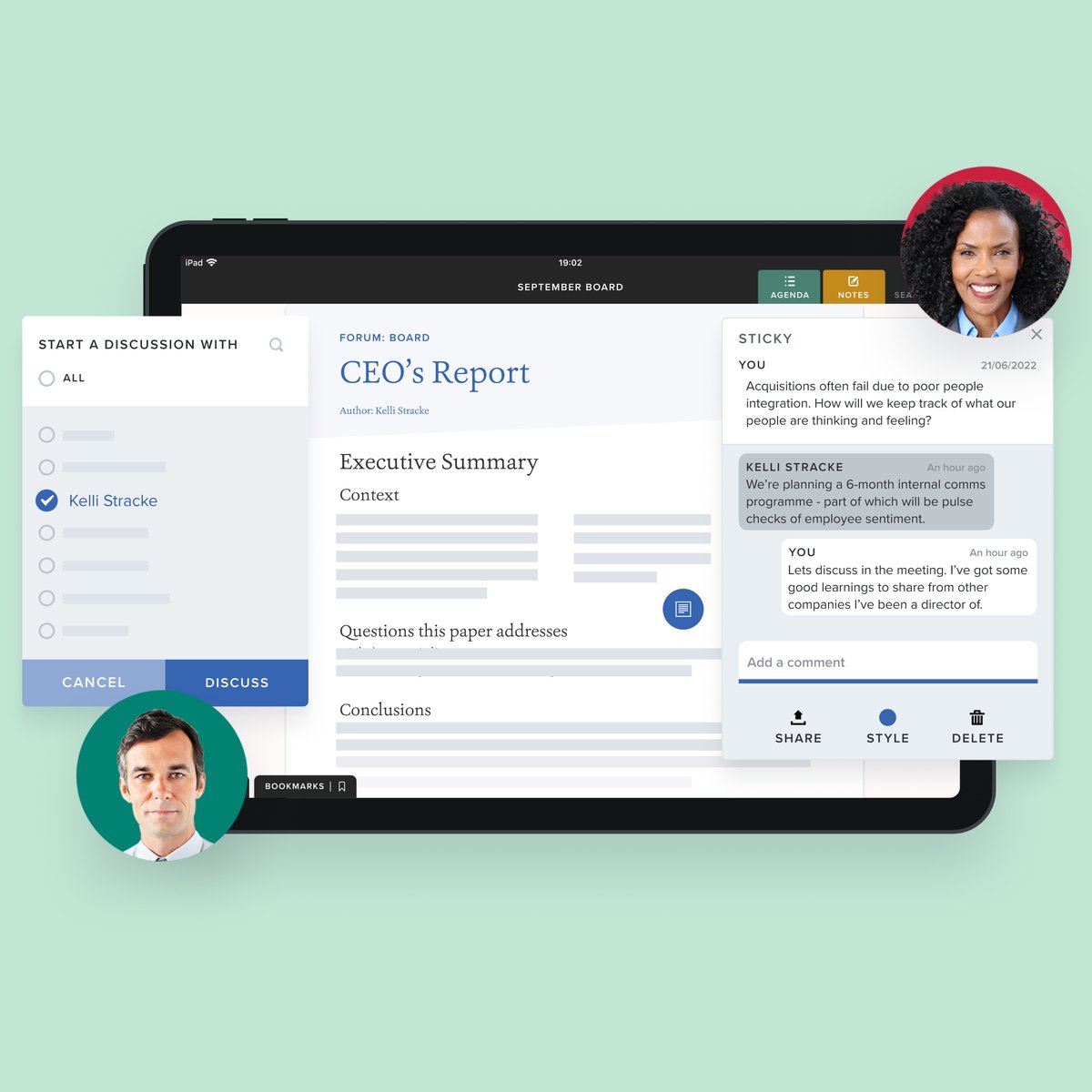
Annotation tools built into the reading experience allow directors to flag passages, add private notes, or share comments with the full board. This replaces the fragmented offline feedback that typically arrives by email and that governance teams then have to manage manually.
The key is that annotations should persist across document revisions. If a director has annotated a paper and that paper is then updated, their annotations should carry forward. Any platform that loses annotations on republication creates more work, not less.
4. Meeting integration
Board communication software should connect directly to the meeting workflow, not operate in isolation from it. The most effective platforms link document distribution to agenda management, so directors can see which paper corresponds to which agenda item, access related materials from previous meetings, and track how recurring topics have developed over time.
This is what distinguishes true board software from general collaboration tools. A platform that handles document storage but has no role in agenda planning or meeting preparation is solving only part of the problem. Agenda Planner extends this further, managing forward plans across all forums from a single view and tracking strategic priorities and regulatory coverage with smart insights and analytics.
5. Audit trails and accountability
Governance requires evidence. A board portal that can confirm which directors accessed which papers, when they were read, and which documents were formally approved provides the audit trail that regulators and governance codes increasingly expect.
Read confirmations also serve a practical purpose independent of regulatory compliance. When a chair knows that three directors have not yet accessed the pack two days before a meeting, they can act on that information. Without an audit trail, that visibility simply does not exist.
For regulated industries, financial services in particular, the ability to produce a clear record of board communication and director engagement with materials is not an administrative nicety. It is a corporate governance requirement.
When a chair can see which directors have read the pack before a meeting, it changes the conversation. You’re not starting from zero. You’re building on preparation that’s already happened — and that’s where the quality of board discussion improves most. "
Anna Scholes, Senior Director at Board Intelligence
The best software for managing board communication
The platforms below represent the most credible options currently available. Each has genuine strengths. The right choice depends on the size and complexity of your board, your governance requirements, your security standards, and how much you want the software to support decision quality as well as administration.
|
Platform |
Core strength | Best for | Key differentiator |
|
Board Intelligence |
Smart AI meets board effectiveness partner | Boards prioritising effectiveness and reporting quality | Board paper quality, Insight Driver for meeting prep and critical thinking, research-backed board effectiveness methodologies |
|
Diligent |
Enterprise breadth | Large, complex organisations with multi-entity governance | Wide governance ecosystem; ESG and risk tools |
| Ease of use | Boards prioritising speed of adoption | Clean interface; strong mobile experience | 20-30 mins |
| BoardPAC | Governance controls |
Security-conscious boards in regulated sectors |
Board-specific meeting workflow and approval tools |
| Azeus Convene | Meeting administration | Governance teams with complex meeting workflows | Paper distribution, approvals, and minutes integration |
Board Intelligence
Board Intelligence’s board portal centralises document storage and distribution, supports version control, access permissions, secure collaboration, and offline access across all devices. The platform handles the full pack production workflow: governance teams can collate papers from writers, apply consistent branding and formatting, and distribute the final pack, all from one place.
What distinguishes Board Intelligence from most alternatives is that it treats communication as part of a wider governance effectiveness problem, not just an administrative one. The platform connects to Report Writer, which embeds the QDI Principle to improve the quality of board papers themselves, and to Insight Driver, an AI-powered meeting preparation tool that highlights trends, surfaces gaps, and expands the context available to directors across reporting cycles. Better communication infrastructure improves meeting efficiency. But the tools that raise the quality of board discussion are the ones that improve what directors are reading and how they prepare to engage with it.
For boards looking to go further, IQ — Board Intelligence’s AI sparring partner — is designed to stress-test thinking and surface underrepresented perspectives before decisions reach the room.
Board Intelligence is approved for government data, offers 24/7 human support, and holds a 4.8/5 rating on G2 based on verified user reviews.
Diligent
Diligent is the largest player in the board management software market by revenue and client base. Its platform covers a wide range of governance functions, from board meeting administration and document management through to ESG reporting, risk management, and entity management.
Its breadth makes it particularly well suited to large, complex organisations that need a single governance ecosystem rather than a point solution. The trade-off is that breadth can come at the cost of simplicity. For boards whose primary requirement is effective communication and meeting management rather than enterprise-wide governance infrastructure, Diligent may offer more than is needed.
OnBoard
OnBoard positions itself primarily on ease of use. Its interface is clean and its mobile experience is strong, which makes adoption straightforward for directors who are not naturally technology oriented.
The platform covers the core requirements: secure document distribution, annotations, meeting management, and basic audit trails. It’s a credible option for boards that want to move away from email quickly and with minimal friction. Organisations with more complex governance requirements or an ambition to improve the quality of board discussion, rather than simply digitise its administration, may find it less well suited to their needs over time.
BoardPAC
BoardPAC focuses on governance-specific functionality with a strong emphasis on security and meeting controls. It offers features including e-signatures, voting, resolutions, and granular access permissions, which makes it a natural fit for regulated organisations in sectors such as financial services, where those specific capabilities are expected.
Its interface is functional rather than particularly intuitive, and its broader ecosystem is more limited than some alternatives. For boards whose priority is security-first compliance functionality rather than user experience or document quality, it is worth evaluating.
Azeus Convene
Azeus Convene covers the core board portal use case well: document distribution, annotations, meeting management, minutes, and approvals. It has a broad international client base and supports multiple languages, which makes it a practical choice for boards operating across multiple jurisdictions.
Like BoardPAC, its strengths are primarily administrative. It handles the logistics of board meetings competently. Organisations looking for software that also supports the quality of board information and director preparation will need to supplement it with additional tools.
How to choose the right board communication software
There is no single right answer. The best platform for your board is the one that matches how your board works and what it most needs to improve.
For a detailed framework on selecting board technology, read our five-step guide to choosing the right board portal.
Start with five questions:
- What is your board's primary problem? If it's document chaos and version control, most platforms will solve it. If it's the quality of discussion and the usefulness of papers to directors, you need software that addresses that directly.
- What are your security requirements? Regulated organisations should verify compliance certifications before shortlisting. Government data requirements will narrow the field further.
- How technically confident are your directors? A platform that governance teams love but directors find difficult to navigate will underperform. Adoption depends on the full board, not just the governance team.
- What does your existing governance workflow look like? Software that integrates with your agenda planning and paper production processes will embed more quickly and deliver more value than a standalone document repository.
- What do you want the software to enable in two years' time? Choose a platform whose roadmap aligns with where your governance ambitions are heading, not just where you are today.
For a broader view of how communication software fits into overall board effectiveness, and what the research says about the factors that move the needle on board performance, our state of board reporting is worth reading alongside this.

With the “easiest to use board portal on the market”, powered by enterprise-grade security, first-rate support, and features that set your board and governance team up to succeed.
Book a demonstrationFAQs
-
What is board communication software?
Board communication software is a category of board portal software designed specifically to help boards share information, collaborate securely, and manage communication around meetings and decisions. It replaces email and generic collaboration tools with a purpose-built environment that includes version control, access permissions, audit trails, and meeting integration. The best platforms do more than digitise existing workflows: they improve the quality of information directors receive and the conditions in which decisions are made.
-
What features should board communication software include?
At a minimum: end-to-end encrypted document storage and distribution, role-based access controls, annotation and collaboration tools, meeting integration, read confirmations, and a clear audit trail. For regulated organisations, e-signature capability, voting tools, and formal resolution management are also standard requirements. The most effective platforms extend beyond these basics to support the quality of board papers and director preparation, not just the mechanics of distribution. Some organisations also use board evaluation tools alongside their portal to assess how well the board is using the information it receives.
-
How does board communication software improve decision-making?
Our Board Value Index found that poor-quality information, rigid or inconsistent decision-making processes, unclear roles and responsibilities, and poor time management in meetings are the four leading barriers to effective board decision-making. Board communication software addresses the information quality barrier directly: by ensuring directors have timely access to accurate, current materials through a secure channel, it removes the version confusion and fragmentation that undermine preparation. Platforms that also support the quality of the papers themselves, rather than simply their distribution, have the most direct impact on the quality of board discussion. For guidance on how to improve director preparation specifically, see our article on how high-performing directors prepare for board meetings with AI.
-
Is board communication software secure?
The leading platforms are built to enterprise security standards. Look for ISO 27001 certification, end-to-end encryption, and role-based access controls that can be applied at the document level. Some platforms, including Board Intelligence, are approved for government data, which represents one of the more demanding security benchmarks available. Any platform being evaluated for a regulated organisation should be able to produce its security certifications and data processing agreements on request. For more on Board Intelligence's approach to security, read our security and resilience guide.