A bank asks who ultimately owns one of your subsidiaries. A regulator asks whether that subsidiary's filings are up to date. An auditor asks what your group structure looked like on 31 December. Three different people, three different reasons, three deadlines you did not set.
Each of these questions should take minutes to answer. For a lot of governance and company secretarial teams they take days. Answering all three on demand takes one centralised, structured approach to entity management.
What do these questions have in common?
People outside your control ask precise, time-sensitive questions, and your team answers them against a clock someone else set. That is the shared pattern.
Each asker wants something narrow. The bank wants a named list of ultimate beneficial owners with evidence behind each layer. The regulator wants a confirmed status. The auditor wants the structure as it stood on a specific date.
Your team can usually find every piece. Someone holds the shareholder register, someone else keeps the board minutes, a third person logs into the registry portal, and a fourth remembers the restructure that moved two subsidiaries under a new holding company. Each of those steps adds a handoff, and each handoff adds hours. That is where the days go.
The bank asks: who are the ultimate beneficial owners of this entity?
A bank asks this during onboarding, during periodic review, or before it will process a significant transaction. Know your customer (KYC) rules require banks to identify the real people who ultimately own or control a corporate customer, and to evidence how they reached that conclusion.
The question sounds simple. Answering it means tracing ownership up through every layer of the structure until you reach named individuals, then showing the documents that prove each step: share certificates, registers, resolutions, and any changes since the last review.
Compliance officers at the bank cannot close the check until every layer is evidenced. If your team rebuilds that chain from documents held across different systems and different people, each layer becomes a separate request and a separate wait. Meanwhile the account stays unopened or the transaction sits pending, and the commercial deadline attached to it moves closer.
The bank's process does not create the delay. Your records do, when they sit in a form that cannot produce a verified ownership chain on request.
The regulator asks: is this subsidiary's filing status current?
A regulator asks whether a specific entity's filings are up to date, and often asks about directorship history alongside it: who was appointed when, who resigned, and whether every change was filed within the deadline.
The hard word in that question is "current." Filing status changes at the registry, not in your files. A submission gets accepted, rejected, or queried after your team sent it. A director resignation gets filed by a local agent in another jurisdiction and confirmed by email. An internal spreadsheet records what was true the last time someone updated it.
Without a system that checks your records against the registry itself, your team can only report the last time someone looked. Answering with confidence then means checking again, entity by entity and jurisdiction by jurisdiction, before anyone will put a statement in writing to a regulator. For a group with dozens of entities across several jurisdictions, that verification pass is the work, and it is why a question with a one-word answer takes a week. We've set out what Companies House filing automation can and cannot do in more detail, including where the human approval gate sits.
Book a demo and see it in action.
Book a demoThe auditor asks: what does the full group structure look like as of this date?
An auditor asks for the complete group structure at a fixed point in time, usually the financial year end. They need it to confirm the consolidation scope: which entities belong in the accounts, what the ownership percentages were, and which entities entered or left the group during the year.
The difficulty here is the date. Most entity records show the position now. Answering an audit request means showing the position then, which requires knowing what changed, when it changed, and what the structure looked like before it did.
If your system overwrites records instead of versioning them, nobody can produce that historic view directly. Your team reconstructs it from resolutions, transfer documents, and the memory of whoever ran the restructure. That reconstruction happens again at the next audit, and the one after that, because the work produces a document and leaves no durable record behind. Company secretaries repeat the same exercise every cycle and get no compounding benefit from having done it before.
What's the common thread?
All three questions share one root cause when they go badly. The data is accurate. It sits in a form that cannot answer a specific question on demand.
Bank compliance officers, regulators, and auditors ask narrow, evidenced questions because their own obligations require it. The gap sits between data that is correct somewhere and data that is centralised, versioned, and structured enough to be queried. Fragmented entity data carries a governance risk well beyond any single request.
That distinction points at a different fix. Adding more people to the scramble makes each individual request faster. Changing where the data lives makes the next one fast by default.
What changes when entity data is centralised?
When your team holds entity data in one structured, current system, answering a bank, a regulator, or an auditor becomes a lookup rather than a project.
The ownership chain is already assembled, so the KYC response goes back the same day. A system that checks your records against the register directly flags where they have drifted apart, so your team fixes the difference instead of hunting for it. Your company secretarial team spends its time on the judgement calls that need a governance professional and stops spending it on assembly.
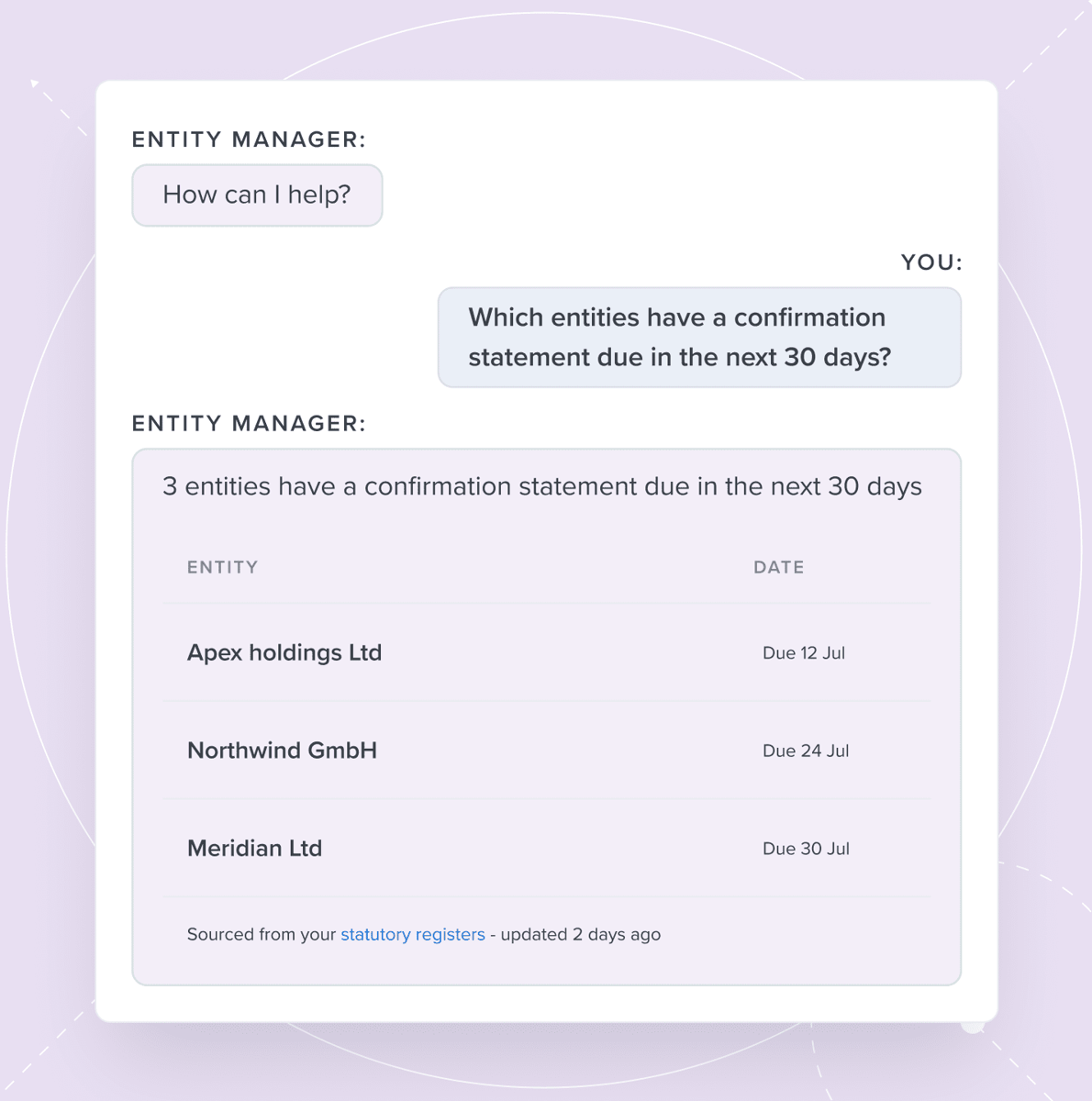
This is what IQ Entities, Board Intelligence's entity management system, is built to do. Intelligent Insight answers regulator, bank, and KYC questions in minutes, not days, drawn from an organisation's own records. Agentic Action automates the administrative work behind that, and nothing happens until a person approves it. Direct filing and read-only register checks run against Companies House today, under the customer's own presenter account, with more registry integrations to follow.
FAQs
-
What is a KYC question in the context of entity management?
A know your customer (KYC) question is a bank's request for evidence of who ultimately owns or controls a corporate customer. In entity management, answering it means tracing ownership through every layer of a group structure to named individuals, and supplying the documents that prove each step.
-
Why do audits require a full group structure?
Auditors need the full group structure to confirm which entities belong in the consolidated accounts and at what ownership percentage. They ask for it as at a specific date, usually the financial year end, so they can also identify entities that joined or left the group during the period under audit.
-
How long should it take to answer a regulator's question about entity ownership?
Minutes, if an organisation keeps entity records centrally and checks them against the relevant registry directly. It takes days when a team has to verify each entity's position across separate systems, jurisdictions, and people before anyone will confirm an answer in writing.
-
What causes delays in answering compliance questions about entities?
Fragmented records cause the delay. When ownership documents, filing confirmations, and board resolutions sit in different systems and with different people, every layer of an answer needs a separate request, and every request adds a handoff.
-
How can entity management software speed up regulatory reporting?
Entity management software holds ownership, directorship, and filing data in one structured, versioned record, so a team can produce an answer without assembling one. Read-only checks against the register remove the verification pass that otherwise happens before anyone will confirm a filing status to a regulator.